Thursday, May 9, 2013

PLEASE AWAKE TO ... THE AWAKENING!

My newest book, THE AWAKENING: A Long Poem Triptych & A Poetics Fragment (theenk Books, Palmyra, NY, 2013) includes an updated version of my essay on “Babaylan Poetics” which I first posted on this blog. To encourage your interest in this book, I’m pleased to share a rather mischievous review written by Kansas-based poet-editor-critic-old coot-animal lover jim mccrary. Here is his review below, which also refers to the brilliant painting I use on the book cover by Fil-Am artist jenifer wofford; jenifer’s painting riffs off of the iconic photograph of General MacArthur’s beach landing on Leyte as he “returns” to the Philippines:


Revooooo by jim mccrary:


The Awakening by Eileen Taboos [sic] is a joy. But first, here is a tale. One of my earliest childhood memories is that of being lifted up onto my father’s shoulders on a crowded street in downtown Chicago in order to “see” General MacArthur pass by in a motorcade. To my father this guy was a big hero who had been badly mistreated in some way by some in power. So….I got the cover image on Eileen’s book because I had seen the original image of MacArthur returning to the Philippines growing in a Chicago suburb in the 1950’s.. Again and again. But don’t ask me the details because I am not much for history and have no idea what the beef was between whoever or what “post liberation” affect was felt on the country being “liberated”. Here is the deal for me, just me. If I had to depend on my knowledge of history to read poetry I would be screwed….ignorant and illiterate. Maybe I am. But that does not, in anyway, lesson the wicked pleasure I receive from reading E. Tabios’s poetry. It just flat knocks me out. Then I wake up and wonder….what was that? And why does my gut hurt…oh right…I was laughing so hard. Or not. And I do know that there is more in all of this, right down thru every line and word and sub-text. I know that this is not just a crazy lady on a big mountain fiddling around with words (isn’t it?)


What ‘gets’ me about her writing is just that bit of getting a reader like me into something as funny as “a séance with William Carlos Williams…” (the first of four sections in this book) knowing also that the twist and turn of the work as it unfolds will sometimes become upended until that poem crashes and bashes through some astounded stuff, some erotic stuff, some his (herstoric) (hersteric) stuff and finally, for me, seems like relief or just plain losing it…the poem ends with a manic repetition of the word “periwinkle”…and why not. Jeez.


The second section titled: 9/11 my forty second birthday…” freaks me out because I was born on 9/10/ummm whatever. So we share, sorta that deal of being conflicted with celebrating a birthday and an ugly day in modern history. It was something to remember that coincident. And Eileen does remember that day in her way…which is usually unique and unabashed simple recording the emails she sent and received across the hours and days following events in NYC. Too me the reading is a window into how a group of loved one and friends “reads” events unfolding before them…the grace and pain and, as ever with Tabios, the poetics of all life surrounding her. What it always comes back too…and for us, the reader, her ability to describe events thru something as un-poetic as email.


The third section of the book is: “The Awakening Of A.” This, again, finds Tabios in her groove and I suddenly feel silly using that phrase before speaking about this poem. But I don’t know how else to do it and apologize if it is desensitive. For this poem, like the previous, is death too. The camps is where it comes from….and you know what that is. A camp….today….Syria, Palestine, Afghanistan, Thailand, Semolina and on and on. Past and present. Here too. Back then. Again, Tabios chooses her way and this time it is HER way, her invention of form called hay (na) ku which is a mini three stanza 6 word ….well…poetics. The striking part of this text is how such simplistic form can carry and relate such incredible weight of experience for one to “visit” and “move among” the people (women) in the camps. To focus on, as instance, menstruation…as image as example as experience…..how such basis can be imagined in some un imaginable environments. Only, and I say this knowing it is meaningless, a poet of otherworldly talents could do what has been done here. I bow in tears falling. Ms. Tabios might disagree somewhat and that’s okay with me………….I know…I know.


This book ends with a prose excerpt from "Babylon [sic] Poetics," a talk Tabios gave as part of a panel in San Francisco about the “avant garde”. I am happy that Tabios and Mr. Tills agreed to include this in the publication called The Awakening. It is a swell passage and explains in her words and feelings what it is she is doing with her poetics. Nicely done it is too. Sorry I missed that panel discussion at Small Press Traffic in San Francisco. But here is a bit of it to close up a really great book. You should track it down….trap it.


Thanks jimbo! And now I'm pleased to share a photo of jim's cat Iris who apparently likes to sleep and purr on moi book! THE AWAKENING, by the way, is available on Amazon or through the publisher theenk books.


Saturday, December 24, 2011

THE AVANT GARDE AND ASIAN PACIFIC ISLANDER AMERICAN POETS

I presented at a panel, "Bay Area APIA Poets and Avant Garde", in San Francisco on December 18, 2011, sponsored by Small Press Traffic. Other panelists were Jai Arun Ravine, Margaret Rhee, Truong Tran, and Jean Vengua, with moderator Barbara Jane Reyes. I present my presentation notes below, as its point of view is a manifestation of "Babaylan Poetics."


APIA AVANT GARDE, Small Press Traffic, Dec 2011

I’m a poet who tries never to challenge what others say about my work. Some have criticized my poems. Some have loved my poems. Some have called it Filipino art. Some have called it insufficiently Filipino because I’m presumably a “Language poet.”* Some have called them “avant garde.” My official response? No comment. But I can share my discomfort with the topic at hand: avant garde. You see, I, among other things, do traffic in capitalist kitsch and mass culture. After all, I’m buying presents to place under so called “Christmas trees”—so-called because they’re also known as Hannukah bushes in my household. I’m not really making a joke. Do note my flexibility in accepting the term, Hannukah Bush. You see, I’m generally uncomfortable with the term “avant garde” because it is also a notion of separation, whether it’s separation from a particular type of politics, aesthetics or culture.

I am equally uncomfortable by instances where the term has evolved to focus more on aesthetic attempts to widen the outer limit of the artistic form. I note this as an aside today because the matter is an extra complication when considering Asian or Asian American work because we're tossing in there that which may be called "ethnic". In the past I have read elliptical poetry that doesn't seem particularly innovative but is deemed innovative when there's an ethnic marker popping up in its lines. Because it may be that touch of exotica to a reader uninitiated about Asian culture that, for them, renders the poem "new."


As a Filipino, including Filipino-American, poet, I come from a background—and thus write from a background—where colonialism has intruded and in some quarters continue to intrude. When I try to write from—and I do wish to write from—a more archetypal space than what's defined through a post-colonial lens, I remember this beloved image—an image from so-called indigenous or pre-colonial Philippine times. It's of a human standing with a hand lifted upwards such that if you happened to be at a certain distance and were to take a snapshot, it would look like the human was touching the sky.

That is the moment, the space, from which I attempt to create poems. In the indigenous myth, the human, by being rooted onto the planet but also touching the sky, is connected to everything in the universe and across all time, including that the human is rooted to the past and future—indeed, there is no unfolding of time. In that moment, all of existence—past, present and future—has coalesced into a singular moment, a single gem with an infinite expanse. In that moment, were I that human, I am connected to everything so that there is nothing or no one I do not know. I am everyone and everything, and everything and everyone is me. In that moment, to paraphrase something I once I heard from some German or Star Trek, “No one or nothing is alien to me.”

On the other hand, I think of how the avant garde, by fulfilling its role of critiquing something be it cultural or political, is inherently pushing for separation, or rather separations. In the avant garde, don’t you leave something behind for something else?

****


As regards poetry, I don't believe it's the poet's role to say whether a poem succeeded—and I believe this because I believe a poet only begins the poem and it's the audience or reader that completes it. So I wouldn’t want to advocate which of my poems, if any, have been successfully created from the archetypal space I described. Instead, I'd like to present an artwork by someone else that I believe fits my notion of what is avant garde: the Filipino American artist jenifer k. wofford. I believe her approach in some of her work is related to mine in poetry. An example is her “MacArthur Nurses” painting or series which take off from the iconic image of General Douglas MacArthur and other soldiers wading onto Philippine shores during World War II.


This is MacArthur landing on Leyte on Oct. 20, 1944, thus fulfilling a promise he had made 2.5 years earlier to the people of the Philippines to return: he returned with an enormous invasion force and the largest assemblage of naval vessels in the history of mankind. For MacArthur, the liberation of the Philippines from the Japanese was the culmination of the war. jenifer k. wofford took that image and reconstituted it into new paintings.


She replaced the figures of MacArthur and others who accompanied them back to the Philippines with Filipino nurses. The artist says the nurses could be conquering some new land or returning to their homes after many years—the fact that one image could capture both ends of the diaspora, which of course is the reality for many Filipinos, is brilliant. But I read this image further as autobiographical. jenifer k. wofford isn’t a nurse but the Filipina nurse is really among those in the front lines—the metaphorical avant garde—of the contemporary Filipino diaspora.

So the iconic image of MacArthur's return is not new. But wofford renewed it into her own. The evocation of departure and return is no longer that of an American general but of the diasporic citizenry in which there resides in many places, many individuals, a longing to return. My own family is filled with examples of people who’ve immigrated overseas for jobs, only to retire back to the Philippines as soon as they are able. It's an image that resonates, and certainly among Filipinos such that the Filipino overseas worker has been transcended individually into a so-called "national hero" in the Philippines, much in the same way that the new TIME magazine cover calls "The Protester" its TIME Person of the Year. jenifer k. wofford presents herself by presenting, not the individual let alone her individual self, but by presenting the many.

And no doubt about it: this work is adamantly avant garde by long-held tenets of avant gardism—it is a critique of the corruption and ineffective political strategy in the Philippines that forces the country to send its people overseas for work. Also a critique of the culture—whether you call it tribal or paternal—that makes corruption the state of play in terms of allocating resources to the country’s development. Also a critique of globalism and its many dark corners: from abused mail order brides to poorly paid workers to actual domestic slavery in some quarters…and so on.

Just as jenifer k. wofford did not effectuate such a moving work in isolation, I attempt new poems mired in the socio-political, which means inherently the autobiographical self. I’ll note some techniques I’ve used that overlap with some approaches used by some poets who’ve been called avant garde. These would be collage, the use of found material, the reliance on the materiality of language and last but not least abstraction. But I don’t use these techniques to get away from the self, my self (which some poets have said as a motivation). I use these techniques to include others (for example, others’ texts). And as regards abstraction, I don’t use that technique to say nothing autobiographical; I use it to listen to others. That is, if others interpret my abstract poems in the way a viewer may interpret an abstract painting, there is content coming from another person and my job as poet is to listen after I’ve provided the microphone. I am there, listening.

My avant garde self, in other words, is not a singular “me” or a self that fluctuates in identity. (When I was more active as an Asian American cultural activist, I remember the phrase often banded about: The fluctuating versus fixed self –I’ve used that, too, when forced to describe my work but I’m belatedly realizing it’s a reductive description. My self is an “ourselves.”) It is ourselves. This “ourselves” may empathize with many goals of the avant garde, but doesn’t separate from what is being critiqued. What evokes the protest is also part of that all-encompassing indigenous timeless space of human rooted to both planet and sky, thus being at one with the universe across all time. If I am an avant garde poet, it’s not because “I” am avant garde. It would be because we, all of us, are. This We, that is holding my hand writing the poem.


+++++++
Footnote *: This is
also a misunderstanding of Language Poetry, a poetics I happen to much admire. But I wasn't insulted by the charge (because I admire those Langpos). I did lose ten pounds laughing about the "charge," however. As I was a tad overweight from all those Napa Valley wines, I appreciated the moment...

Saturday, April 2, 2011

POETS ON ADOPTION

Well if there's ever a project I'd consider to be the perfect manifestation of "Babaylan Poetics", it'd be POETS ON ADOPTION. You are invited to peruse the offerings there where, as I describe:
Poetry: it inevitably relates to -- among others -- identity, history, culture, class, race, community, economics, politics, power, loss, health, desire, regret, language, form and genre disruption, love ... as well as the absences thereofs. The same may be said about Adoption.

As probably a minor aside, what I like about doing projects like POETS ON ADOPTION is that it cuts across schools, cliques, styles within the poetry world--an example of bringing together certain people who otherwise might not get together. So, POA's inaugural issue brings together various poetry styles from, say, flarf to storytelling to elliptics to lyric to abstract-fragmentation ... I mean, instead of preaching to your choir you should expand the numbers in said choir! The resulting song, to continue torturing this clichetic metaphor, might be more interesting.

Moi is ever here to bring you all together into one big RAINBOW. Without, hopefully, being rained upon...

Sunday, February 6, 2011

HAPPY 81ST BIRTHDAY MOM!

Last night we celebrated Mom's 81st birthday by going to Go Fish Restaurant. Here she is with Michael, holding up one of her presents, Virgil Mayor Apostol's Way of the Ancient Healer:


Here's a review of Virgil's wonderful book by Leny over HERE!

Friday, November 5, 2010

WALK THE TALK

THIS is an example of "Babaylan Poetics" -- like the best of poetry, it's a verb not a noun.

Sunday, October 10, 2010

BEFORE ECO-POETICS,

there was BABAYLAN POETICS. Here's a new Babaylan video featuring timeless intellectual Leny M. Strobel. What's interesting, among many things, is how the video opens. It features Virgil Mayor Apostol (of the infamous FART) opening up one of the events during the Babaylan Conference a few months ago. Specifically, he is talking in Ilokano, saying "Bari, bari" which can be literally translated as "Go away."

But it's not an aggressive order for anyone to move away. The chant is more of a charm to drive away unwanted spirits, while allowing benevolent ones to remain. As Virgil explained to me, "This goes back to how our ancestors feared the malevolent spirits, thus much prayers and offerings going to them, rather than the good ones since they did no harm. Therefore, the focus on the chant for the opening is for the purification of the space, and everyone within."

Virgil adds, "The burning of anglem (cloth incense) is universal in northern Luzon, and used for various circumstances from the birth of a child, illness, to the death of an individual. With its inclusion in the opening ceremony, its purpose is to drive away these malevolent spirits."

Very interesting, and a helpful explanation to me since, when I first heard of the literal translation, I was struck by its use. That is, since the Babaylan is about community and inclusiveness, I found it interesting that this "Go away" is the opening. Mom said that the chant also refers to how, as we walk the earth, we are telling the spirits to move away so that we do not inadvertently step on them or otherwise harm them with our movements.

In the video opening, Virgil also goes on to say to the spirits, "We do not want anything from you..." I like that! My initial reaction was: Well, how's that for anti-colonialism!

These chants go ... deep (grin).

You know, ever since the Babaylan conference at Sonoma, I'd be walking about Galatea's mountain chanting, "Bari, Bari..."

Mom used to shush Moi, saying I'd actually bring the spirits here. Thing is, those spirits never left Moi. Blood memory and all that. Wink.

Friday, October 8, 2010

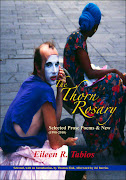
A BABAYLAN-IC PERSPECTIVE ON REVIEWING THE THORN ROSARY


I am so grateful to Leny M. Strobel for her engagement with my book THE THORN ROSARY in the new issue of Moria Poetry! Here is an excerpt--though you can see entire review HERE:
Once upon a time the eyewitness to the rituals of a Babaylan (http://en.wikipedia.org/wiki/Babaylan; http://www.babaylan.net) told of her altered states of consciousness when she did her healing, her communing with the spirits. They didn’t understand her language but they accepted the efficacy of her relationship with the spirit world. They trusted her. They knew she had access to this world. (Why else did the Spanish friars in the 15th century embark on the project of exterminating these Babaylans?). [3]

Does a poet like Eileen also perform, symbolically, the role of a Babaylan? If the Babaylan is able to ferry a person in-between worlds, or is able to summon a wandering soul back to the body, or plead with the spirits to be kind and generous, or negotiate a propitiation—can a Babaylan-inspired poet do the same?

Sometimes reading poetry, for me, is learning how to dive for one’s own meaning. In diving one learns, senses, embodies. This I have learned from my engagement with Eileen’s body of work over the past decade. [4]

If according to Archbishop Fulton Sheen, The Rosary is “a meditation for the blind, the simple, the aged.” is it then possible that the The Thorn Rosary is that which pricks the meditation in order to return us to our own bodies? Our bodies that aren’t blind, not simple, not aged.

Isn’t this the work of babaylan poetics—to walk the angel back into its body in unborrowed light. Eileen creates her own light, a luminosity that is also sorrowful, joyful, glorious…the light is unborrowed because it has already taken upon itself all that there is—the world into the poem. It doesn’t ask for a return, only an invitation to dance. The dance of the babaylan.

Isn’t this what the babaylan does? She dances. In wholeness. In ecstasy. A body out of time and space. And when she doesn’t literally dance, she writes Poems that dance. The Poem, like this one, takes your hand and leads your sensuous mind, this mind that descends into the body to become whole and sacred:


Restive
—after “on God (en Garde)” by Archie Rand

The farmers are monitoring the sky. Rain dilutes sweetness in the grapes. Knuckles knot into themselves, mimic the knees of hundred-year-old grapevines. The cabernet hang like purple testicles. I am always fingering a bunch. Sometimes I pinch off a globe, split its skin before my lips and suck at its membrane. The farmers measure brix mathematically. I want my body to determine truth like Cezanne painted rocks instead of images. When I see the winged shadow glide over the fruit-laden fields of September’s wine country, I know better than to question how my body doubles over. How my mouth gasps. I feel blood flowing out of a creature, somewhere, felled on its path. Its last vision will be a vulture’s open beak. Sweetness, let the harvest begin under the most livid sun. “Sweetness” —perhaps I mean You, dear “God.” Lord, I am praying for life and living—I am making poems. (161)


Hail Mary, mother of Eileen. Blessed are we and blessed are the fruits of our wombs….

Thank you, Leny. I appreciate this Babaylan-ic perspective for reviewing my newest book. It's a unique gift!

Friday, August 27, 2010

BABAYLANISM AT OUR OWN VOICE

This is actually a reprint of a post I just featured at my primary blog, but I replicate it below for convenience:


BABAYLANISM

OurOwnVoice's newest issue is rather historic by focusing on the Babaylan.

I've got three poems innit, which isn't the most important detail but which I note for moi Blog-File ("Hay(na)ku with Ducktail for Leny", "The Hundredth Monkey Phenomenon," and "Sacred Time"). Again for the Blog-File, I also have the novel "Dear Cloud" innit.

Having gotten Housekeeping out of the way, I found this essay by Cynthia Arias, "An American Babaylan: Living in One's Own Truth" quite useful. It's useful because modern-day Babaylanism is controversial in some circles as people grapple with the effect of the diaspora (and the resultant separation from "land"). Anyway, here's some excerpts from Arias' essay:
The concept that the Babaylan is defined by factors that override an individual’s direct experience of the originating land, the Philippine Islands, is vital to understanding the presence of the Babaylan in the Diaspora and the ways that sacred practices of the Babaylan have, as well, bridged the seas of consciousness that Pilipinos have traversed in their journeys around the world.

...

If we accept that Culture is a human construct, by which a group of individuals agree basic concepts of values, morals, mores to form a worldview, then it follows that Culture evolves as humans evolve.

...

While many may provide their perspectives, and assist in our discoveries, through critical analysis founded in scientific methodology, it is up to us to decide who we are and where we are headed.

Modern-day Babaylanism is empowering.

The Babaylan Conference, which seeded this issue, also empowered Mom to write her first book (which I'm reviewing now). But here is also one of her narratives, a memoir from 1939 entitled "Dawac". Good for Mom!

Also useful is the essay "Ways of the Babaylan" by Katrin de Guia. It's clear from her essay that empathizing/understanding (in my opinion, if you understand Babaylanism, understanding cannot occur without empathizing) cannot occur without that thing that many folks are scared to discuss: love. I do think Ben Okri's quote relevant: "Only those who truly love and who are truly strong can sustain their lives as a dream. You dwell in your own enchantment. Life throws stones at you, but your love and your dream change those stones into the flowers of discovery."

It takes courage to love as a Babaylan would/does. For, as de Guia puts it, "The first priority of the babaylan is the community."

I appreciate Babaylanism because it requires intelligent innocence.

Sunday, August 1, 2010

MOM'S FIRST READING!

As I've mentioned before, my nearly 81-year-old Mom has a first book coming out! In celebration of such, she also had her first "salon" (oh my!) reading experience this weekend, as she read from her narrative (she's calling these memoir-vignettes "narratives") "Dawac" at beautiful Leny's beautiful house (it was so colorfully and, wink, indigenous-ly decorated!). Here's a photo of Mom in her reading chair--do note in the foreground a make-shift "altar" of blessings that Leny created on the spot from vegetables that I brought from my garden (that's when I realized, btw, that you're supposed to harvest zucchinis when they're smaller, not when they become human baby-sized....duh). That's the beautiful back of the beautiful Leny's beautiful head in foreground:


Here's a shot, too, of part of the audience to whom I'm so grateful for their openness and making my Mom feel really welcome as she goes on to her own literary debut. That's Jean on the far-left side of couch! It's not a good photo, but you can see the intentness of the peeps' attention....


At one point in the evening, one lady said that writing must run in my family. And I said half-jokingly, "Yes, but I didn't know it for the longest time!"

And what I was thinking of is that when some talent runs in the family, one usually sees it first in the parent and then in the child. In my and Mom's case, it was seen visibly first -- if one uses publication as a viewsight -- in me and later in Mom. But what this really means is that what was running through our blood is not linear but circular...

...evoking for me indigenous time's mythical space of creativity: where, in the space of creation, there are no delineations between past, present and future, or between geographically-defined space; in that mythical space, unity exists in the universe across all time and space. (Got that? Good!)

Last but not least, I mentioned in my introduction for Mom that "Dawac" is the first narrative in Part One of her forthcoming book, and that Part Two will be a reprint of her Master's Thesis at Silliman University when she had written (under since-recognized Philippine National Artists Edilberto and Edith Tiempo) the first critical study of "local color" in Filipino English-language short story writing. I thought it wonderfully synchronistic that Mom's own narratives will contain much local color, even as I consider her book also a recovery project for what was actually a historic literary study. The circle turns....

Thanks again to Leny for the salon idea and hosting. Thanks for making Mom and me feel so welcome. What a beautiful community you all make!

Saturday, June 12, 2010

POETS FOR LIVING WATERS

I'm pleased to be part of the Poets for Living Waters project curated by Amy King and Heidi Lynn Staples in response to the BP oil spill disaster. Innit with a poem, statement of conscience and explication of Michael and his anti-colony collapse disorder beekeeping. The poem was one I wrote after the disastrous landslides in Guinsaugon, Leyte, Philippines on February 17, 2006.

I was happy, too, to be able to meld some Babaylan Poetics/indigenized POV into that conscience-statement, which I replicate here:
STATEMENT

I am also to blame for the BP oil disaster. I am part of the demand for oil. I do try to limit my footprint on the natural environment, in energy and other matters. For the former, say, a solar field; for the latter, say, hosting bee hives to help mitigate “colony collapse disorder” which also is a way to introduce my son to environmental concerns. But regardless of these steps, I do not wish to avoid acknowledging that I am part of the cause for the tragedy in the Gulf and many other environmental damages—to recognize blame’s expanse is a condition precedent for being part of any solution. As Acoma Pueblo poet Simon J. Ortiz has noted, there is a “moral imperative” to the making of interconnections that require, among other things, pro-active awareness including self-awareness—a stance also inherent in the Filipino indigenous trait of “kapwa” and what I call “Babaylan Poetics.” Ergo, for the BP oil disaster: I am very sorry—I will try to do better.

Colony collapse disorder, landslides from reaping trees from mountain, BP's oil spill in the Gulf -- we are all complicit, because we are interconnected.

Saturday, June 5, 2010

...MAKING THEIR WAY OUT TO THE WORLD...WHICH HAD NEVER LEFT THEIR WORDS...

Okay. So some of the early fruits of creativity spurred on by the Babaylan Conference are now making their way out into the world!

For Mom, this means her memoir-short story "Dawac" has been sent for future publication in the Babaylan Special Issue forthcoming from OurOwnVoice. For me, two poems ("The Hundredth Monkey Phenomenon" and "Sacred Time") from the five Babaylan-poems I've written so far have just been accepted for -- UPDATE: and are now published in -- OCHO 30, a literary journal edited by Didi Menendez.

Here's an excerpt from Mom's memoir "Dawac":
I did not go to school the following day. I wanted to see what a dawac was. Apo Kattim arrived with her assistant. I noticed that she brought a long buneng (long knife) in its wooden sheath. She went to the bedroom to see Eliel right away, then returned to the descanso where we waited. Since the descanso was cleared of all the chairs, Apo Kattim and her assistant remained standing while they talked. My grandmother invited them to the kitchen for coffee. Apo Kattim said coffee would be good because although they had breakfast, they did not have time for coffee.

After they had their coffee, Apo Kattim returned to the descanso and asked to see the coconuts. She nodded her approval when she saw that they were well husked. My mother also pointed to the rolled floor mat placed against the wall. Apo Kattim unsheathed the buneng and place it on the table. She handed the sheath to her assistant who placed it under the table. The assistant took a folded dinwa and placed it on a corner of the table. Apo Kattim and her assistant unrolled the floor mat and spread it on the floor, leaving enough space between it and the wall to allow a person to walk around it. Then Apo Kattim asked for a drinking glass.

“With water?” asked Tiang Ciliang.

“No,” said the assistant, “just the glass.”

Tiang Ciliang went to the kitchen and came back with the drinking glass. The assistant took it and placed it on the table. She placed a long piece of metal beside it.

Apo Kattim looked at all the things on the table then asked for the blanket that she told my mother to prepare. My grandmother brought a folded blanket. Apo Kattim’s assistant took it and spread it on the floor. Apo Kattim told my mother to sit on the blanket. Then she turned to Manong Toring and told him to bring Eliel out. “And cover him with his blanket when you bring him out,” she said.

“And now that Eliel will not be on his bed for sometime, somebody should change all his bed linens,” Apo Kattim suggested.

Manong Toring came back with Eliel in his arms, the blanket trailing the floor.

“Don’t trip on the blanket,” cautioned Tiang Ciliang, walking toward them and catching the part of the blanket that reached all the way down to the floor. If Manong Toring had stepped on that part of the blanket, he would surely have stumbled with Eliel in his arms.

“Put him down here,” directed Apo Kattim, pointing to the spot near my mother. “Sit him facing the wall.”

As soon as Eliel was seated properly, Tiang Ciliang walked to Eliel’s bedroom. Somebody had to change Eliel’s bed linens.

“Move closer to Eliel and hold him up,” Apo Kattim told my mother. “He still can’t sit up by himself.”

Apo Kattim placed the flat basin behind Eliel. Then she turned to us and warned us not to talk or move around while she was doing the dawac. She also told Manong Toring to stand near the stairs and stop the people below from coming up when they heard her chanting, or stop them from talking in loud voices.

Some neighbors must have heard that a mannawac was in our house and they came to satisfy their curiosity. However, they sat on the benches under the house. They did not come up.

Apo Kattim took the dinwa, nodded to her assistant, and sat down near Eliel. She covered her head with the dinwa and extended her right hand. Her assistant gave her the piece of metal. Apo Kattim extended her left hand. Her assistant placed the drinking glass in her hand, guiding Apo Kattim’s fingers to hold the glass securely.

Everyone was quiet. I felt funny in the eerie silence. Apo Kattim started hitting the drinking glass with the piece of metal. The dawac started. Apo Kattim was calling to the anitos and summoning them to come to her assistance.

“O – O – O – O – O – O,” Apo Kattim ‘s ululating cry accompanied by the tinkling sounds of the glass could be heard could be heard by the whole neighborhood.

Umali cayo Isna. (Come here.) Umali cayo ta i- la-enyo od nan masakit ay anac si Inggo.” Apo Kattim was calling the anitos to come and see the sick son of Inggo. (Inggo was my late father’s name.)

“O – O – O – O – O – O. Masegang cayo. (Have pity.) Masegang cayo isnan ubing, Masegang cayo. Umali cayo,” was the repeated cry of Apo Kattim. “Umali cayo ta palaingen yo nan ubing ta umey met maki ayayam issa ayan dey appoyo.” She continued her call, then stopped striking the glass with the metal. Her assistant took the drinking glass and metal from her and put them back on the table.

Suddenly, Apo Kattim stood up, removed the dinwa that covered her head and flung it to her assistant. She looked strange to me, as though she had become a different person. She walked to the table, picked up her buneng, held it high with her right hand above her head, and started dancing around Eliel and my mother, waving her buneng in circular motions. Throughout, she chanted words in the Itneg dialect that I couldn’t understand. I began to be afraid that she might get dizzy and fall with that buneng in her hand. I looked around and saw that Manong Toring also looked concerned and was ready to come to Apo Kattim’s aid in case she fell.

Apo Kattim danced to the table and took one of the coconuts with her left hand, extended it and quickly brought her buneng down, splitting the coconut in halves. I heard everybody gasp in surprise and wonder. Who would expect a frail old woman to have the strength she showed when she split the coconut?


*****

And here's an excerpt from my poem "The Hundredth Monkey Phenomenon":

The nearby sea was calm

its clear water

mirroring distant mangroves and islets

to transform them into clouds

floating in the vast, pale blue—


In her slow and lilting voice

U’po Majiling chanted


Everything begins with a dream—

Tuesday, May 18, 2010

MOM'S FORTHCOMING AND FIRST BOOK!

The Babaylan Conference was so inspiring for Mom that since that weekend, she's been writing memoir-ish stories. In a matter of weeks, she's written enough for a book! And it'll actually be a useful memoir for others outside the family since much of the vignettes have to do with life during World War II, and many of Mom's peers have died or are dying (Mom is 80 years old). I actually already have a publisher for her first short story--fittingly, it will be for OurOwnVoice's special issue on Babaylan Conference Reflections...

Mom actually suffered physically from the prolonged hours spent over the computer writing her memoirs. But it's not unusual for the act of creation to take a toll on the body, the artists' bodies. It'll be worth it, though. Mom agreed with my suggestion to make her book a two-part book. The first part will be her memoirs. The second part will be -- wait for it as it's HISTORIC! -- a reprint of her May 1954 Masters of Arts Degree in English from Silliman University. Mom's thesis was on "The Use of Local Color in Philippine Short Stories in English" -- the first critical study on this topic.

I'm looking at Mom's thesis right now as I type this post--it was approved by the "Graduate Council" chaired at the time by now-Philippine National Artist Edith Tiempo, and Council members were Metta J. Silliman and Philippine National Artist Edilberto Tiempo. (Mom had studied at Silliman University with the Tiempos, but before they set up the writers' program modeled after Iowa University's.) The pages are yellowing...browning....fragile.

It will be great to get this thesis out there!

And here's a picture of my mother Beatriz Tabios reading a copy of THE THORN ROSARY. She happened to be in the kitchen when my copies of the hardback versions were delivered. It's nice to see that she thought my book was worth interrupting her mending of dish towels (grin).


When my father died a few years ago, it was just short of his and Mom's 50th wedding anniversary. It's often said that the first year of widowhood is the most difficult, and for a couple that's been together for so long, it could be even more difficult. In a way, the writing has become a new source of invigoration for Mom, a reason to look forward instead of (what she usually does): look back into her memories.

She looks forward by looking back? Hey -- time just collapsed in that mythic "sacred time and sacred place" where creativity fluorishes! Woot! And it's all because, at the last minute and a tad bored around the house, she decided to attend the Conference with me. She loved it so much she returned for the second-day attendance. And, now, she's pouring out her own contribution to ... Light!

Tuesday, May 11, 2010

"BEYOND THE FRAME"

As I was saying, I've always felt that the Poem is only begun by its author, and that it needs to be completed by its reader or audience. Here's a "videotext" done by someone I don't know but who apparently did it for a class at Skyline College -- now THIS is what I'ma talkin' about when I say I need to see a poem mature beyond my hands--in this case, the poem "No Title Required":


Isn't it gorgeous! Thank you to WHOEVER!

Here's another example of a text-dance done on another poem, "The Secret Life of an Angel" (which in turn had been inspired by Jose Garcia Villa's poem, "Girl Singing"). This is an old poem for me, but I notice the line innit: "...I chant like the Babaylan I will become..." -- Hmmm. Anyway, this was created by London-based Mexican poet Ernesto Priego--muchas gracias!


*****

Okay, so if you want to meet She who inspires the above and you are in New York City this Thursday, please come by the following and let me have you, per the first video above, "quaff some sweet jerez"--I promise that if you do, we'll have a good time without me having to "eat your testicles":

MARSH HAWK PRESS SPRING BOOK LAUNCH!

You are all cordially invited to:

Spring Book Launch Party
May 13th, 2010
7:00 PM — 9:00 PM

Celebrating New Titles by Phillip Lopate, Eileen R. Tabios, Sandy McIntosh and Neil de la Flor

Ceres Gallery
547 West 27th, St Suite 201, New York, NY 10001
Phone and fax: 212-947-6100

Wonderful wine and food will be available!

FOR MORE INFORMATION, including directions, please go to the Marsh Hawk Press website HERE.

Friday, May 7, 2010

EMPIRE VS. COMMUNITY--OLDER CHILD ADOPTION

I thought I had it all figured out, you see, about this Friday's (today's) reading/presentation at Small Press Traffic. For the past couple of weeks, I had planned to present poems contextualized within a discussion of how Western critics have described my work, versus what I feel now to be the more truthful underlying aspect to what I've done as a poet: IKSP (Indigenous Knowledge Systems and Practices). I thought that a discourse on the Western gaze might be a doorway into SPT's themes of "empires" and "community" which my talk is supposed to address.

But whenever I tried to prepare for it in the last few days, something just didn't feel right. Again, it all just seemed too much about Me, Myself and I. Finally, I got the sign -- an article in Wednesday's New York Times about Russian orphanage life, a matter raised by the prior news of a U.S.-American Mom recently returning her son to Russia where she'd adopted him. Like many who've gone through adoption (especially international adoption or "older" child adoption, both of which I've done), I've not stopped pondering how Torry-Ann Hansen of Tennessee sent her adopted 7-year-old son Artem Saveliev back home to Russia by himself with a note demanding the adoption be annulled.

In fact, as soon as I heard the news last month, I immediately thought to post an article on my other blog, The Blind Chatelaine's Keys, about how wonderfully my son Michael is doing (I adopted Michael from Colombia last year when he was 13; he turned 14 in March and has been in our family now for just over a year). In thinking to do a blog post in response to Torry-Ann Hansen's failed adoption, I had planned to make sure to include key phrases for Googling purposes like "Hansen adoption," "Russian orphan," "international adoption," etc. For I had wanted that blogged article about Michael's successful integration into a new (our) family, new school, new country, new language and so on to be an internet antidote to the coverage of the Hansen family difficulties. Why? Because estimates reach as high as 200 million for orphans worldwide, and the most difficult category for its members to get adopted are "older boys."

"Older", here, can mean four years or older or, for the context of the program I went through to adopt my son, seven years and older. It's horrible -- it's like, in some circles, if a boy gets past seven--or four!--years of age, people give up on them.... Michael was 13 when I adopted him--we were the first ever to express adoption interest in him (he'd already been in an orphanage for about six years); if things had not worked out with the adoption, the odds are that he would have stayed in the orphanage until he aged out of the system.

There clearly is a lot of fear and misconception out there about adopting older children (and specifically older boys), and while I've long blathered as a proud Mama over Michael's achievements since he joined our family, I didn't write the Hansen-reaction post. Because before I successfully adopted my son, I went through earlier attempts to adopt...and failed.

My first failed adoption effort is detailed in a "haybun" entitled "Looking for M." that I wrote on the plane ride from Bogota to San Francisco, published in The Blind Chatelaine's Keys (later reprinted in THE THORN ROSARY). Note what this "blurb" partly says:
“‘Looking for M.' is not just deeply moving but also educational about one of the most complicated difficulties in adoption attempts: reactive attachment disorder. Eileen Tabios reveals her psychic wounds to educate the public about the potentially dire consequences of orphanhood. M.'s story is the story of so many orphans whose interior lives are often invisible. Ms. Tabios gives them a voice through poems I read over and over, saddened that the emotions I feel become physical.”
—Sherrell J. Goolsby, Executive Director of World Child International

I don't know if the Tory-Ann Hansen matter involves a child with reactive attachment disorder, but it's clear that there were attachment problems -- my empathy with any parent in that position prevented me earlier from writing about the Hansen adoption. For while I think the decision to put a 7-year-old on a plane back to another country by himself is majorly knuckle-headed, I also know that most people interested in adoptions are not sufficiently trained or sensitized to deal with many of the issues that accompany children who've spent significant periods of time in institutions. And, it's not unusual in international adoption cases that a child's background may not be fully known or shared with adopting parents. This doesn't mean that older-child adoptions should not occur; the majority of adoptions succeed! -- but it does mean that bureaucracies worldwide involved in finding families for orphans need to do a significantly better job in preparing participants. And those interested in being adoptive parents need to get with the preparation program and not simply believe Love will conquer All.

The preparation of the adopting families is often given short shrift. The formal preparation that I was obliged to do in order to adopt (e.g. ten hours for an internet course) was inadequate. After my failed adoption attempts, I prepared myself -- in part by reading every single adoption related book I could find. That research was critical preparation because, later, when some problems came up that were to be expected of a child with an institutionalized background, our family was prepared to deal with them. The media coverage of the Tory-Ann Hansen failed adoption seems to indicate that the mother was not prepared to address the problems that surfaced.

Regardless of how many adoptions occur, no matter how much attention is raised by celebrities ranging over Angelina Jolie to Sandra Bullock, we are not anywhere near addressing the huge global humanitarian catastrophe posed by neglected orphans. But the answer is not simply placing children in families (though that step already is so difficult). As with many issues, education needs to occur. The complications related to raising formerly institutionalized children does not mean these children are not adoptable and can't thrive in new families. But there is a spectrum of complications with these children, and the more that potential parents are prepared, the more likely the adoption will succeed.

The social effects of neglecting this issue is huge -- one adoption counselor I met during my process said a social worker once told her, "In the orphanages, we are breeding millions of serial murderers." The quote, though perhaps exagerrated bears a kernel of truth: it relates to how some (some not all) children raised without family, raised in institutional settings, sometimes fail to develop their ability to attach to other people which, in turn, can have psychopathic results.

I obviously can't summarize all the issues in this blog post, but I will say that addressing this as part of my SPT reading (partly with readings from "Looking for M.") would seem to be more "moral[ly] imperative" (ref. prior post) than discussing how critics in the past have responded to my poems. As regards community, the plight of orphans requires no less than a global village approach. As regards empire, everything relates to empire; the article on Russian orphanages offers just one deplorable example:
The Russian government spends roughly $3 billion annually on orphanages and similar facilities, creating a system that is an important source of jobs and money on the regional level — and a target for corruption.

As a result, it is in the interests of regional officials to maintain the flow of children to orphanages and then not to let them leave, child welfare experts said. When adoptions are permitted, families, especially foreign families, have to pay large fees and navigate a complex bureaucracy.

“The system has one goal, which is to preserve itself,” said Boris L. Altshuler, chairman of Right of the Child, an advocacy group in Moscow, and a member of a Kremlin advisory group.

“That is why the process of adoption in Russia is like going through the circles of hell,” he said. “The system wants these children to remain orphans.”


*****

Meanwhile, yes -- Google me through these phrases: "adoption", "Hansen adoption," "older child adoption", "Russian orphan," "international adoption," among others. And when you get to this site, let me tell you about my son Michael -- someone who once was considered by some people around him to be "a lost cause":

Adopted at age 13. At the time of his adoption, he was only in 4th grade in an orphanage one-room school situation in Colombia. Six months later, he is slotted into 7th grade (because of his age) in one of California's top public schools. At said excellent public school, he swiftly became honor roll. In less than a year, he is communicating well in English. He's developed into a reader--he reads himself to sleep every night. Last quarter, he received three top-of-his class certificates in addition to his A-average Honor Roll certificate.

In sports, he was on a championship soccer team, as well as does well in other sports new to him, from skiing to tennis to swimming. He also just received an awards certificate in P.E.--he can run a mile in just over six minutes.

His hobbies include building model rockets, photography, drawing (he's an excellent artist), bee-keeping, skateboarding, movies and exploring the night-sky through telescopes.

He knows his manners, is engaged with people, and has developed a witty sense of humor. He loves our two dogs and two cats -- when our cat was injured, he helped take care of her for six weeks so that, by the end of the healing process, the cat (which formerly was too skittish to approach him) was fully bonded with him.

He is sensitive and compassionate--today, he was telling me about seeing a group of drivers from a Ferrari rally, and thinking that those drivers need to have spent all the money acquiring their cars for "better" reasons, like solving the plight of poor people. When he's helped me bring food to the local food pantry, I can see his eyes observing, assessing, and ... caring, even as it also bolsters his fortitude for making something of himself (which he defines for now as attending college).

He wrote his first English-language poem recently and, as I note in my unbiased literary critique (feel free to go to link for the whole thing), "A close reader no doubt would glean the expansiveness of this 14-year-old’s world view—this poem is not written from [just] a personal 'I'."

I could go on. The point is: if you're prepared--and you can be prepared,

            OLDER CHILD ADOPTION WORKS.

I've long felt there were two demographically-created dots that needed more connections: the first is the baby-boom generation which include many who've deferred having children (because of career-concerns), and the second are "older children" (do you really want an infant when you're already hitting age 50?). These are matches waiting to be made--this is a community needing to be expanded. This is Kapwa waiting eagerly to unfold.

Thursday, May 6, 2010

GALATEA RESURRECTS ... TOWARDS "SOMETHING ELSE"

Galatea Resurrects, the poetry review journal I edit, is another Kapwa-based project which began long before I focused on the word/concept "Kapwa." To date, and based solely on volunteerism by all participants involved -- and volunteerism is also known as "kusang loob" -- this site has presented 776 new poetry reviews (covering 343 publishers in 17 countries so far) and 64 reprinted reviews (to bring online a variety of reviews previously available only viz print).

The just-released 14th issue also contains my "first in a series of experimental engagements focused on gleaning indigenous Filipino traits in the poetry of Filipino poets located in the diaspora." My inaugural attempt at indigenous literary criticism focuses on three publications:
INSIDES SHE SWALLOWED by Sasha Pimentel Chacon
(West End Press, Albuquerque, NM, 2010)

EASTER SUNDAY by Barbara Jane Reyes
(ypolita press, San Francisco, 2008)

Simon J. Ortiz: A Poetic Legacy of Indigenous Continuance, co-edited by Susan Berry Brill de Ramirez and Evelina Zuni Lucero
(University of New Mexico Press, Albuquerque, NM, 2009)

While this version is fine for Galatea Resurrects' purpose, it's a tad rough in places and over time I'll no doubt smoothen such. But what I did like about this article is how it ended--I didn't know how it was going to end, but I just plodded along to see what would happen as I wrote the longish article. And, with the help of the words of Acoma Pueblo poet Simon J. Ortiz, the article ends by noting the "moral imperative" to the making of interconnections:
to hear ..., more deeply, the implied stories of conquest, racism, manifest elitism, and interpersonal isolation

Indigenization requires a lot of work (too much work to be "flakey", in my opinion). To "hear" in the above is to listen but also to act.

And so I was pleased at how this first attempt at an indigenized literary criticism ended up leading me to conclude that the point of the project ultimately is not the resultant essay. It is
something else, a something else that I now realize from writing this review, and without yet knowing its particular manifestations, is simply a better world.


*****

Kapwa as "Shared Life"--including how all species co-exist harmoniously, like kitty Artemis and dawgie Achilles:

Wednesday, May 5, 2010

BABAYLAN LODGE, PART II

In an earlier post, I talked about returning to my studio, "Babaylan Lodge," after the Babaylan Conference. When I arrived there, I had to look around for a while as I'd forgotten what, over recent years, I'd stored there (until I returned, it was "out of sight, out of mind"). Looking at various spots and items now, I sense that the space had been patiently waiting for my return, patiently because I hadn't been ready at the time the structure was built to be located in it. Here are some interior shots -- some signs:

My computer is positioned in front of a bulletin board. I'm struck now how, directly over my writing computer is a poster featuring an early book launch for the Babaylan anthology--which is to say, Babaylan always kept watch over my writing:


Bulol spirits feed me!


Barbies in search of decolonization. Talk about colonized--Mattel took over a former U.S Military Base in the Philippines to turn it into a factory, in which they made Barbies. I picked up these "Philippine Barbies" for a project exploring (post)colonialism while I was once at Manila Airport. They now grace the fireplace featuring a carved deer because deer a-bounds all over the mountain:


A decolonized Barbie (she's out of her box) sits on the trophy I received for the Manila Circle National Book Award in Poetry for Beyond Life Sentences. When one is decolonized, one enters Poetry. Here's the NBA trophy by Napoleon V. Abueva, considered the "Father of Modern Philippine Sculpture" and the youngest ever to receive the designation of Philippine National Artist. Nearby is a photograph of a Filipina dancer by brilliant photographer Rhett Pascual. You can also see hanging on the far wall a portrait V.C. Igarta did of me when I used to visit him in his New York studio:


In 1999, I'd curated a reading by Filipino poets to commemorate the centennial anniversary of the Philippines' declaration of independence from Spanish colonialism. The reading took place at the Puffin Gallery in New York City which, for the occasion, was hung with works by Filipino artists in an exhibit entitled ""The Art of Resistance: Social Realists." I fell in love with this painting by Jose Tence Ruiz (scroll down link for more powerful images!)--the image of a blindfolded angel struggling to rise out of a garbage heap resonates for so many reasons: it's a metaphor for the Philippines' struggle for development...and for a poet's struggle...and for civilization to continue amidst horror....and I can go on and on about this work, but instead will just show the powerful image:


So many items of a past waiting for my return! Like, this wooden statue in front of a notice of a poetry reading I once did in Philadelphia (?) with that most excellent poet Ron Silliman. If I recall correctly, this woman's hair raised upwards into a cone upon learning of a lover's betrayal (?), and I always thought to offer her refuge...:


But of course -- a lady crafted from delicated Philippine shells. Beneath her, a wooden angel from New Mexico, I think, that was gifted by a former yoga teacher...I used to do a lot of yoga, which makes sense, as back in the day I was promiscous about what I let my mind pay attention to--so I think that angel is by some books exploring the philosophy of masochism or some such back-into-concrete idea that I was exploring in poetry...:


From the kitchen and looking out into the primary loft area, one can see the luminous Ganesh (from a trip to India):


A Buddha head in front of the only CD anthology I've ever participated in, this one sponsored by Gargoyle magazine:


This bowed position has always -- still does -- move me. Atop some Nota Bene Eisweins:


I once collaborated with June, a local artist, to create a glass mural of how I reconfigured the myth of Galatea (after whom my home is named). This was one of the paper drafts of the mural that would come to be placed on the wall of the wine cellar:


Birds carved from mushrooms atop bookshelves of books as "inventory" (partly from what I publish through Meritage Press):


The bed doesn't really belong here. We moved in a bed so the lodge could be used as an occasional guest house as I'd not been using the space.


Pressed paper with front drawing created from white correction fluid by brilliant Pinay artist Reanne Estrada:


A wide-angle shot featuring Santiago Bose's drawing on handmade paper atop the front door


A drawing--"Queen Puso" (1993" by Corazon Ugalde-Yellen, a Pinay artist whose work I saw at an exhibit of emerging Filipino artists at the now-defunct Puro Arte Gallery in Los Angeles when I visited there to do a poetry reading. I've always appreciated how she stands in front of what I'd earlier thought of as 'the paradox of a blue but night sky." Now that I've learned about the indigenous "sacred time and sacred place", I realize that there's no paradox at all in that sky--it's just eternal for all time:


[TO BE CONTINUED...AS I MOVE INTO THE SPACE]
Part I is HERE.

Saturday, May 1, 2010

KAPWA, "SHARED LIFE", IN ACTION...THROUGH A POEM!

Alternative Title: Why I Tear Up Poetry Books!

I've always felt that the Poem is only begun by its author, and that it needs to be completed by its reader or audience. I'm pleased to share the latest incarnation of a completed poem by Cynthia M. Phillips: jewelry!!!! Gal's after my own heart! Here are pics--the first on the kitchen island, next to photos of my beloved cats Artemis and Scarlet:


Second photo of me wearing them as I pick up a bronze figurine that once resided with brilliant poet kari edwards:


Cynthia, the jewelry designer, explains some of the conceptual underpinnings to the purty bracelets--
1) Haiti--red: blood. Green for rebirth and renewal

2) "I consider the woman's choice in liberating / a red dress with pale green sandals" (a line from a poem in Beyond Life Sentences / later in THE THORN ROSARY)

I love it -- am so particularly happy when artists take on some of my poems...Thank you, Cynthia! And I'm cutnpasting below an excerpt from my presentation at the Literature Panel for the Babaylan Conference that relates as well to Cynthia's engagement--

--which also explains why, when I do gigs, I like to rip up my poetry books!!! To wit:


from "Dawac/Action: Babaylan Poetics" (with performance notes for Tearing Up Book!):

In the Philippines’ central Ilocos Sur area where I was born, the Babaylan is known as Man-nawac. “Man-nawac,” from the Itneg language, can be translated as “a healer and caller of spirits.” The Man-nawac heals by invoking the help of the anitos or spirits.

I learned about the Man-nawac from my mother who shared how she, as a child, once witnessed a Man-nawac heal her grandmother. This Man-nawac was also a relative: Apo Ak-kam. In terms of ars poetica, three points reverberated with me from my mother’s account of Apo Ak-kam’s process:

First, the healing process involved the Man-nawac calling to the spirits through statements (“Please come, please come…”) to almost ululating sounds (“woooo…wooo…woooo”). In other words, the Man-nawac does not heal others on her own; she calls to others—she must involve others.

Second, the healing process had to begin on or about high noon. My mother said that noon was the time when the most people in the community would hear the Man-nawac’s calls to the spirits. For me, the significance of noon relates to maximum light and maximum involvement of the community (versus a time like, say, midnight when most people would be asleep).

Third, while the Man-nawac was calling for the spirits to help heal my mother’s grandmother, my mother’s grandfather was on the other side of a curtain where he stood with five beaded strings. Five times, my mother’s grandfather would raise a beaded string over the curtain and each time the Man-nawac would cut off one string, releasing the beads from their tether. By the third time that the Man-nawac cut a beaded string, it was clear that the Man-nawac was “fully possessed” by the spirits….and on through to the cutting of the fifth string. For me, this relates to how, I conceive of a poem’s creation as one where the poet’s role is not to write the poem so much as to be the tool through which a poem is written. The poem writes itself—as Jose Garcia Villa once noted, I believe, about the author’s hands, “The,hands,on,the,piano,are,armless,”. The poem is more than the poet.


As a poet, I call out to you through poems. I don’t consider (my) poems to be art objects—things to be read or looked at from a distance. I offer the poem as an open hand, a space for engagement with others. If no one reaches forth to take my hand, if no one found my poem sufficiently engaging or of interest, then the poem never reached fruition.

And this is why, I approach you now with poems, these from my book Nota Bene Eiswein:

[Tear sheets from Nota Bene Eiswein and hand out to people in audience, explaining...]
1) My poems don’t mature if they remain unread, if no one engages with them….so I give them to you.

2) Note that by tearing out pages, I am destroying a book. Well, yes, the publication is not important….the poem may be what’s printed on the page. But Poetry is not something trapped by a page; it’s an engagement involving others beyond its author.

3) When I give you pages, they may be fragments – incomplete excerpts of poems…that’s fine. A poem is inherently a fragment—it is began by the author, but it can only mature into wholeness if it’s engaged by a reader; an audience.

Poetry is verb. A poem may be words. But Poetry is an act. Poetry is engagement.

Friday, April 30, 2010

A FOCUS ON POET-EDITORS, WITH A HISTORIC INTRODUCTION

My newest Kapwa-based project, a special themed issue on Poet-Editors has just been released by Otoliths, edited by poetically-stellar Mark Young. I talk more about this issue's rationale in my Editor's Introduction from which I think one can glean several indigenous values: community-making, holistic-ness, volunteerism, cultural advocacy (and I'm not just talking about myself but about many of the 43 poet-editors who discuss why they volunteer their efforts as editors). So I hope you enjoy this issue.

AND! Concurrent with the issue's release, a special Shout Out about it is posted at the Poetry Foundation Blog by Barbara Jane Reyes--click HERE for her lovely SHOUT.

Now, have you heard of the Poetry Foundation? Publisher of historic Poetry Magazine. And at its mainstream space, Barbara was kind enough to feature a statement, to wit:
I’m so happy that an issue devoted to poet-editors is out, and am grateful to Otoliths and the visionary Mark Young for publishing it! I explain more about the issue’s rationale in my Editor’s Introduction. What I don’t mention there is, with hindsight, the most important factor about it: this project reflects my eternally-held “Babaylan Poetics.” The Poet-Editor issue is a community-inspired performance act reflecting the Filipino indigenous value of “Kapwa” or “Shared Life” (interconnections). I’ve been an editor for as long as I’ve been a poet, and have also worked in such roles as “critic” and “publisher”; as a poet, I’ve also worked in multi-genre forms. Kapwa means there’s no schism between such forms and roles. Kapwa was a generative source for the Poet-Editor issue because Kapwa encourages the search for commonalities among peoples and creatures; in this case, the commonality was of poets who also serve as editors.

Bang the gongs: This is HISTORIC. The Poetry Foundation is widely read, and I bet you that 99.999999% -- of its readership has never heard of "Kapwa" until I guerilla-ized that word onto its space. All this within two weeks of the equally historic Babaylan Conference. I tell ya -- I love how Kapwa makes a loving guerilla out of me-becoming-Us!

Reference IKSP: "Biro". Mischief is one of my more succesful conceptual underpinnings for poetry projects...(Wink!)

Thursday, April 29, 2010

I GOT A COMPLAINT OVER MY BODY!

I am a body in relation to other bodies
--Leny M. Strobel, from Introduction to
BABAYLAN: Filipinos and the Call of the Indigenous

The fabulously cerebral poet-scholar-critic Joi Barrios emailed recently. She complained! Okay, not really. But she said that she and others apparently wished that I had read more of my own poems during my presentation at the Literature Panel for the Babaylan Conference. I did read an excerpt from one poem but otherwise blathered prose and tore up a poetry book (more on that latter bit of theater later). But Joi said, when it comes to poetry, the poet's voice matters, you know.

Yes, I know. [Insert sigh.] But I actually haven't been eager to do poetry readings for many years now. There are many reasons...and it's all complicated. Not the most important reason because I do love my ego ("I love my ego"--get it?), but one reason I haven't done much is the whole process just seemed so ... narcissistic. Perhaps I've witnessed too many poets desperate to be heard (it's not that I don't understand the debilitating effect of not being heard, in poetry or otherwise; but I just don't ... want to be like that ...?). Perhaps I just haven't gotten the right type of feedback, like Joi letting me know of her response to my panel presentation. Anyway, simplistically, it's seemed pointless to me because the usual poetry reading is about the poet presenting his/her/hir poems and it all just seems so "me-me-me."

I once read an article about a poet who, in doing poetry readings, always begins or includes one poem by someone else. That, I thought, was fabulous. Kapwa et al. But think about it for the millions (yeah, right) of you who attend poetry readings. How often do you see poets share poems by others?

But, it is true--as Joi sez--that a poet's reading can embody a poem/poetic engagement. So I now shall give you all the ability to view and touch my body in person at an upcoming reading for the lively Small Press Traffic (SPT) in San Francisco. This reading may be of particular interest to this blog's readers as I plan to raise my new-found exploration of indigenous values--since my reading, after all, is part of the SPT series themes of "empire" and "communities". I hope to see you there next Friday -- we might even share ... gas (heh).
SMALL PRESS TRAFFIC

May 7, 2010

Eileen Tabios and Susan Gevirtz

Small Press Traffic
Literary Arts Center at CCA
1111 -- 8th Street
San Francisco, California 94107
smallpresstraffic at gmail
415-551-9278

Susan Gevirtz's recent books include Aerodrome Orion & Starry Messenger (Kelsey Street Press), broadcast, and Without Event: Introductory Notes (forthcoming from eohippus labs). Along with teaching locally at various Bay Area institutions, with Greek poet Siarita Kouka she runs The Paros Symposium, on Paros island, an annual meeting of poets and translators from Greece and the United States.

Eileen R. Tabios' publications include 18 poetry collections, two novels, an art essay collection, a poetry essay/interview anthology, and a short story book. She most recently released THE THORN ROSARY: SELECTED PROSE POEMS & NEW (1998-2010), selected with an introduction by Thomas Fink and an afterword by Joi Barrios. She wishes more people attending her poetry readings would bring her food.

Okay--I inserted in that last sentence in my bio at the last minute. After all, I want to swallow ... You!*


__________
*Moments like this are what make me wonder over why people take me seriously...

Wednesday, April 28, 2010

EFFECTIVENESS, NOT CO-OPTATION

Reflecting on yesterday’s posts, I want to say that the effectiveness of indigenous values concerns me more than its objectified artifacts. I said that I was interested in psychology because I’m focused more on those values—and, for one of my purposes, how they can come to create a type of literary criticism currently lacking for Filipino poetry (and all too rare, generally speaking). As with making a poem, the end goal won’t be the artifact of the review or anthology of indigenized reviews—the goal is something larger, an opening up by a still-unknown audience (and me) into…something else. (Bahala na—let’s see what that something else will be.)

But we do know that indigenous values, whether or not they are labeled as such (and that’s what’s so great about these books I’m reading—the ability to name things because people have chosen to write theories), do work even in a modern context. Intuition, for instance, is closely-aligned with the ability to conceptualize/create versus simply follow orders and rules—which is more likely to create or expand a new company?

And politics. Remember the first People Power’s Revolution in the Philippines that overthrew the Marcos dictatorship and went on to inspire other such people power’s movements in other countries? That act succeeded because of the indigenous value of pakikibaka, or together-as-one. (I remember my young self as a Barnard College student doing a political science thesis on the Philippines--and how in that thesis I had expressed doubt over that country's Communist effort as so much of that seemed more rooted in poverty and political corruption, versus a belief in Marxism. As recently as last year, in response to political corruption in the Philippines, a despairing Fil-Am writer expressed his concern that It may have to take a (violent) revolution after all to resolve things. I remember my empathy for this writer's frustrated assessment, but it occurs to me now that political movements based on Kapwa and pakikibaka have more of a chance at success than the exported Communism.)

The ability to tap into community and have a larger desire create something is a very effective force. My very first book was BLACK LIGHTNING.One of its facets was that it was a book desired by the reading community, versus a book I concocted *in my own room* and then attempted to pitch to publishers. BLACK LIGHTNING was a huge success—and I talk more about this in the Introduction to a special issue on Poet-Editors that will be published by Otoliths (I’ll update link when the issue goes live later this week).

And if I look at everything I’ve done so far as a poet—a modest career as a writer for only encompassing 14 years so far—I’ve been prolifically published. To be a prolific writer is one thing, but the publication of one’s writings is a different step. Sure, I could say I’ve found many publishers because I’m a good writer—but many good writings are overlooked. My secret is Kapwa, its practice long before I knew its word: I can trace every writerly achievement to the root source of me having first tried to do something else on behalf of others. That’s the melding of Kapwa and Bahala Na—you live in the indigenous spirit without looking for rewards and yet the rewards come in terms of you thriving as a person and, in my case, poet. And I’ve done this without donning ethnic garb (unless Halloween counts) .

But let me digress to mention a baby elephant in the room (Hello Elephant!). When we start discoursing on the indigenous, people and concepts that may seem “flakey” come out of the woodwork. Whatever, you know. I’m not going to diss someone for wearing symbols—we have to wear something and I’m not going to say my German Shepherd pendant is less flakey than the silver bracelet etched with Baybayin (btw, I love my Babaylan jewelry). But we need to not judge the indigenization movement based on these trappings. The flakes that should be dismissed are those forcing themselves into an indigenizing community as a leader of sorts—someone to be followed. I’ve been contacted now by people trying to claim me as their own in exchange for presumably some spiritual revelation….Look, if you’re a leader, you don’t have to try hard to find followers, you know what I mean? If you have something relevant to say, the community will recognize you. Until then, try to manifest your interest in indigenous values in ways other than a power play, okay?

Effectiveness. How to assess said effectiveness? Look at the results. Is there something coming into existence—for the good of community/world—as a result of the results? Is there something being created versus a movement-for-the-sake-of-having a movement; is there something going on besides the creation of navel-gazing or socializing groupings? Was a book created that ended up empowering some of its readers? Was a dictator overthrown? Was a new company hatched? Did an environmental movement to green the world unfold? Et al...

The indigenous spirit is like poetry (which is why I say poetry has provided me good training): words can’t fully capture the indigenous spirit because one has to live it, not talk it.

*****

Community and activism are forces that can create new lovely poems, especially if one is willing to abide by Bahala na (note that this Indigenous value has been debased into it being interpreted as passivity, when its true nature is one of courage—courage in the face of not knowing what will happen. I often write poems, not to say something but to discover what needs to be said).

In earlier essays and talks, I’ve raised my belief that Poetry is a Doorway Into Something. I’d like to share two examples, for which new poems were created by myself and other poets in order for these projects’ successes. Both of these projects were effective in actually raising money (I’s got the beef, son!) for poverty relief and Haiti relief. These are—
"Hay(na)ku for Haiti" relief, about which information is available HERE.

"Tiny Poetry Books Feeding The World...Literally!", about which information is available HERE

These projects involve community, involve the indigenous notion of Kusang Loob (volunteerism), bowed to respecting/preserving nature (and core to indigeneity is a tie with nature), among other things, as well as created new poems. I hope you will check out the links…and even participate!