Saturday, June 12, 2010

POETS FOR LIVING WATERS

I'm pleased to be part of the Poets for Living Waters project curated by Amy King and Heidi Lynn Staples in response to the BP oil spill disaster. Innit with a poem, statement of conscience and explication of Michael and his anti-colony collapse disorder beekeeping. The poem was one I wrote after the disastrous landslides in Guinsaugon, Leyte, Philippines on February 17, 2006.

I was happy, too, to be able to meld some Babaylan Poetics/indigenized POV into that conscience-statement, which I replicate here:
STATEMENT

I am also to blame for the BP oil disaster. I am part of the demand for oil. I do try to limit my footprint on the natural environment, in energy and other matters. For the former, say, a solar field; for the latter, say, hosting bee hives to help mitigate “colony collapse disorder” which also is a way to introduce my son to environmental concerns. But regardless of these steps, I do not wish to avoid acknowledging that I am part of the cause for the tragedy in the Gulf and many other environmental damages—to recognize blame’s expanse is a condition precedent for being part of any solution. As Acoma Pueblo poet Simon J. Ortiz has noted, there is a “moral imperative” to the making of interconnections that require, among other things, pro-active awareness including self-awareness—a stance also inherent in the Filipino indigenous trait of “kapwa” and what I call “Babaylan Poetics.” Ergo, for the BP oil disaster: I am very sorry—I will try to do better.

Colony collapse disorder, landslides from reaping trees from mountain, BP's oil spill in the Gulf -- we are all complicit, because we are interconnected.

Saturday, June 5, 2010

...MAKING THEIR WAY OUT TO THE WORLD...WHICH HAD NEVER LEFT THEIR WORDS...

Okay. So some of the early fruits of creativity spurred on by the Babaylan Conference are now making their way out into the world!

For Mom, this means her memoir-short story "Dawac" has been sent for future publication in the Babaylan Special Issue forthcoming from OurOwnVoice. For me, two poems ("The Hundredth Monkey Phenomenon" and "Sacred Time") from the five Babaylan-poems I've written so far have just been accepted for -- UPDATE: and are now published in -- OCHO 30, a literary journal edited by Didi Menendez.

Here's an excerpt from Mom's memoir "Dawac":
I did not go to school the following day. I wanted to see what a dawac was. Apo Kattim arrived with her assistant. I noticed that she brought a long buneng (long knife) in its wooden sheath. She went to the bedroom to see Eliel right away, then returned to the descanso where we waited. Since the descanso was cleared of all the chairs, Apo Kattim and her assistant remained standing while they talked. My grandmother invited them to the kitchen for coffee. Apo Kattim said coffee would be good because although they had breakfast, they did not have time for coffee.

After they had their coffee, Apo Kattim returned to the descanso and asked to see the coconuts. She nodded her approval when she saw that they were well husked. My mother also pointed to the rolled floor mat placed against the wall. Apo Kattim unsheathed the buneng and place it on the table. She handed the sheath to her assistant who placed it under the table. The assistant took a folded dinwa and placed it on a corner of the table. Apo Kattim and her assistant unrolled the floor mat and spread it on the floor, leaving enough space between it and the wall to allow a person to walk around it. Then Apo Kattim asked for a drinking glass.

“With water?” asked Tiang Ciliang.

“No,” said the assistant, “just the glass.”

Tiang Ciliang went to the kitchen and came back with the drinking glass. The assistant took it and placed it on the table. She placed a long piece of metal beside it.

Apo Kattim looked at all the things on the table then asked for the blanket that she told my mother to prepare. My grandmother brought a folded blanket. Apo Kattim’s assistant took it and spread it on the floor. Apo Kattim told my mother to sit on the blanket. Then she turned to Manong Toring and told him to bring Eliel out. “And cover him with his blanket when you bring him out,” she said.

“And now that Eliel will not be on his bed for sometime, somebody should change all his bed linens,” Apo Kattim suggested.

Manong Toring came back with Eliel in his arms, the blanket trailing the floor.

“Don’t trip on the blanket,” cautioned Tiang Ciliang, walking toward them and catching the part of the blanket that reached all the way down to the floor. If Manong Toring had stepped on that part of the blanket, he would surely have stumbled with Eliel in his arms.

“Put him down here,” directed Apo Kattim, pointing to the spot near my mother. “Sit him facing the wall.”

As soon as Eliel was seated properly, Tiang Ciliang walked to Eliel’s bedroom. Somebody had to change Eliel’s bed linens.

“Move closer to Eliel and hold him up,” Apo Kattim told my mother. “He still can’t sit up by himself.”

Apo Kattim placed the flat basin behind Eliel. Then she turned to us and warned us not to talk or move around while she was doing the dawac. She also told Manong Toring to stand near the stairs and stop the people below from coming up when they heard her chanting, or stop them from talking in loud voices.

Some neighbors must have heard that a mannawac was in our house and they came to satisfy their curiosity. However, they sat on the benches under the house. They did not come up.

Apo Kattim took the dinwa, nodded to her assistant, and sat down near Eliel. She covered her head with the dinwa and extended her right hand. Her assistant gave her the piece of metal. Apo Kattim extended her left hand. Her assistant placed the drinking glass in her hand, guiding Apo Kattim’s fingers to hold the glass securely.

Everyone was quiet. I felt funny in the eerie silence. Apo Kattim started hitting the drinking glass with the piece of metal. The dawac started. Apo Kattim was calling to the anitos and summoning them to come to her assistance.

“O – O – O – O – O – O,” Apo Kattim ‘s ululating cry accompanied by the tinkling sounds of the glass could be heard could be heard by the whole neighborhood.

Umali cayo Isna. (Come here.) Umali cayo ta i- la-enyo od nan masakit ay anac si Inggo.” Apo Kattim was calling the anitos to come and see the sick son of Inggo. (Inggo was my late father’s name.)

“O – O – O – O – O – O. Masegang cayo. (Have pity.) Masegang cayo isnan ubing, Masegang cayo. Umali cayo,” was the repeated cry of Apo Kattim. “Umali cayo ta palaingen yo nan ubing ta umey met maki ayayam issa ayan dey appoyo.” She continued her call, then stopped striking the glass with the metal. Her assistant took the drinking glass and metal from her and put them back on the table.

Suddenly, Apo Kattim stood up, removed the dinwa that covered her head and flung it to her assistant. She looked strange to me, as though she had become a different person. She walked to the table, picked up her buneng, held it high with her right hand above her head, and started dancing around Eliel and my mother, waving her buneng in circular motions. Throughout, she chanted words in the Itneg dialect that I couldn’t understand. I began to be afraid that she might get dizzy and fall with that buneng in her hand. I looked around and saw that Manong Toring also looked concerned and was ready to come to Apo Kattim’s aid in case she fell.

Apo Kattim danced to the table and took one of the coconuts with her left hand, extended it and quickly brought her buneng down, splitting the coconut in halves. I heard everybody gasp in surprise and wonder. Who would expect a frail old woman to have the strength she showed when she split the coconut?


*****

And here's an excerpt from my poem "The Hundredth Monkey Phenomenon":

The nearby sea was calm

its clear water

mirroring distant mangroves and islets

to transform them into clouds

floating in the vast, pale blue—


In her slow and lilting voice

U’po Majiling chanted


Everything begins with a dream—

Tuesday, May 18, 2010

MOM'S FORTHCOMING AND FIRST BOOK!

The Babaylan Conference was so inspiring for Mom that since that weekend, she's been writing memoir-ish stories. In a matter of weeks, she's written enough for a book! And it'll actually be a useful memoir for others outside the family since much of the vignettes have to do with life during World War II, and many of Mom's peers have died or are dying (Mom is 80 years old). I actually already have a publisher for her first short story--fittingly, it will be for OurOwnVoice's special issue on Babaylan Conference Reflections...

Mom actually suffered physically from the prolonged hours spent over the computer writing her memoirs. But it's not unusual for the act of creation to take a toll on the body, the artists' bodies. It'll be worth it, though. Mom agreed with my suggestion to make her book a two-part book. The first part will be her memoirs. The second part will be -- wait for it as it's HISTORIC! -- a reprint of her May 1954 Masters of Arts Degree in English from Silliman University. Mom's thesis was on "The Use of Local Color in Philippine Short Stories in English" -- the first critical study on this topic.

I'm looking at Mom's thesis right now as I type this post--it was approved by the "Graduate Council" chaired at the time by now-Philippine National Artist Edith Tiempo, and Council members were Metta J. Silliman and Philippine National Artist Edilberto Tiempo. (Mom had studied at Silliman University with the Tiempos, but before they set up the writers' program modeled after Iowa University's.) The pages are yellowing...browning....fragile.

It will be great to get this thesis out there!

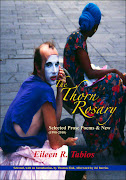
And here's a picture of my mother Beatriz Tabios reading a copy of THE THORN ROSARY. She happened to be in the kitchen when my copies of the hardback versions were delivered. It's nice to see that she thought my book was worth interrupting her mending of dish towels (grin).


When my father died a few years ago, it was just short of his and Mom's 50th wedding anniversary. It's often said that the first year of widowhood is the most difficult, and for a couple that's been together for so long, it could be even more difficult. In a way, the writing has become a new source of invigoration for Mom, a reason to look forward instead of (what she usually does): look back into her memories.

She looks forward by looking back? Hey -- time just collapsed in that mythic "sacred time and sacred place" where creativity fluorishes! Woot! And it's all because, at the last minute and a tad bored around the house, she decided to attend the Conference with me. She loved it so much she returned for the second-day attendance. And, now, she's pouring out her own contribution to ... Light!

Tuesday, May 11, 2010

"BEYOND THE FRAME"

As I was saying, I've always felt that the Poem is only begun by its author, and that it needs to be completed by its reader or audience. Here's a "videotext" done by someone I don't know but who apparently did it for a class at Skyline College -- now THIS is what I'ma talkin' about when I say I need to see a poem mature beyond my hands--in this case, the poem "No Title Required":


Isn't it gorgeous! Thank you to WHOEVER!

Here's another example of a text-dance done on another poem, "The Secret Life of an Angel" (which in turn had been inspired by Jose Garcia Villa's poem, "Girl Singing"). This is an old poem for me, but I notice the line innit: "...I chant like the Babaylan I will become..." -- Hmmm. Anyway, this was created by London-based Mexican poet Ernesto Priego--muchas gracias!


*****

Okay, so if you want to meet She who inspires the above and you are in New York City this Thursday, please come by the following and let me have you, per the first video above, "quaff some sweet jerez"--I promise that if you do, we'll have a good time without me having to "eat your testicles":

MARSH HAWK PRESS SPRING BOOK LAUNCH!

You are all cordially invited to:

Spring Book Launch Party
May 13th, 2010
7:00 PM — 9:00 PM

Celebrating New Titles by Phillip Lopate, Eileen R. Tabios, Sandy McIntosh and Neil de la Flor

Ceres Gallery
547 West 27th, St Suite 201, New York, NY 10001
Phone and fax: 212-947-6100

Wonderful wine and food will be available!

FOR MORE INFORMATION, including directions, please go to the Marsh Hawk Press website HERE.

Friday, May 7, 2010

EMPIRE VS. COMMUNITY--OLDER CHILD ADOPTION

I thought I had it all figured out, you see, about this Friday's (today's) reading/presentation at Small Press Traffic. For the past couple of weeks, I had planned to present poems contextualized within a discussion of how Western critics have described my work, versus what I feel now to be the more truthful underlying aspect to what I've done as a poet: IKSP (Indigenous Knowledge Systems and Practices). I thought that a discourse on the Western gaze might be a doorway into SPT's themes of "empires" and "community" which my talk is supposed to address.

But whenever I tried to prepare for it in the last few days, something just didn't feel right. Again, it all just seemed too much about Me, Myself and I. Finally, I got the sign -- an article in Wednesday's New York Times about Russian orphanage life, a matter raised by the prior news of a U.S.-American Mom recently returning her son to Russia where she'd adopted him. Like many who've gone through adoption (especially international adoption or "older" child adoption, both of which I've done), I've not stopped pondering how Torry-Ann Hansen of Tennessee sent her adopted 7-year-old son Artem Saveliev back home to Russia by himself with a note demanding the adoption be annulled.

In fact, as soon as I heard the news last month, I immediately thought to post an article on my other blog, The Blind Chatelaine's Keys, about how wonderfully my son Michael is doing (I adopted Michael from Colombia last year when he was 13; he turned 14 in March and has been in our family now for just over a year). In thinking to do a blog post in response to Torry-Ann Hansen's failed adoption, I had planned to make sure to include key phrases for Googling purposes like "Hansen adoption," "Russian orphan," "international adoption," etc. For I had wanted that blogged article about Michael's successful integration into a new (our) family, new school, new country, new language and so on to be an internet antidote to the coverage of the Hansen family difficulties. Why? Because estimates reach as high as 200 million for orphans worldwide, and the most difficult category for its members to get adopted are "older boys."

"Older", here, can mean four years or older or, for the context of the program I went through to adopt my son, seven years and older. It's horrible -- it's like, in some circles, if a boy gets past seven--or four!--years of age, people give up on them.... Michael was 13 when I adopted him--we were the first ever to express adoption interest in him (he'd already been in an orphanage for about six years); if things had not worked out with the adoption, the odds are that he would have stayed in the orphanage until he aged out of the system.

There clearly is a lot of fear and misconception out there about adopting older children (and specifically older boys), and while I've long blathered as a proud Mama over Michael's achievements since he joined our family, I didn't write the Hansen-reaction post. Because before I successfully adopted my son, I went through earlier attempts to adopt...and failed.

My first failed adoption effort is detailed in a "haybun" entitled "Looking for M." that I wrote on the plane ride from Bogota to San Francisco, published in The Blind Chatelaine's Keys (later reprinted in THE THORN ROSARY). Note what this "blurb" partly says:
“‘Looking for M.' is not just deeply moving but also educational about one of the most complicated difficulties in adoption attempts: reactive attachment disorder. Eileen Tabios reveals her psychic wounds to educate the public about the potentially dire consequences of orphanhood. M.'s story is the story of so many orphans whose interior lives are often invisible. Ms. Tabios gives them a voice through poems I read over and over, saddened that the emotions I feel become physical.”
—Sherrell J. Goolsby, Executive Director of World Child International

I don't know if the Tory-Ann Hansen matter involves a child with reactive attachment disorder, but it's clear that there were attachment problems -- my empathy with any parent in that position prevented me earlier from writing about the Hansen adoption. For while I think the decision to put a 7-year-old on a plane back to another country by himself is majorly knuckle-headed, I also know that most people interested in adoptions are not sufficiently trained or sensitized to deal with many of the issues that accompany children who've spent significant periods of time in institutions. And, it's not unusual in international adoption cases that a child's background may not be fully known or shared with adopting parents. This doesn't mean that older-child adoptions should not occur; the majority of adoptions succeed! -- but it does mean that bureaucracies worldwide involved in finding families for orphans need to do a significantly better job in preparing participants. And those interested in being adoptive parents need to get with the preparation program and not simply believe Love will conquer All.

The preparation of the adopting families is often given short shrift. The formal preparation that I was obliged to do in order to adopt (e.g. ten hours for an internet course) was inadequate. After my failed adoption attempts, I prepared myself -- in part by reading every single adoption related book I could find. That research was critical preparation because, later, when some problems came up that were to be expected of a child with an institutionalized background, our family was prepared to deal with them. The media coverage of the Tory-Ann Hansen failed adoption seems to indicate that the mother was not prepared to address the problems that surfaced.

Regardless of how many adoptions occur, no matter how much attention is raised by celebrities ranging over Angelina Jolie to Sandra Bullock, we are not anywhere near addressing the huge global humanitarian catastrophe posed by neglected orphans. But the answer is not simply placing children in families (though that step already is so difficult). As with many issues, education needs to occur. The complications related to raising formerly institutionalized children does not mean these children are not adoptable and can't thrive in new families. But there is a spectrum of complications with these children, and the more that potential parents are prepared, the more likely the adoption will succeed.

The social effects of neglecting this issue is huge -- one adoption counselor I met during my process said a social worker once told her, "In the orphanages, we are breeding millions of serial murderers." The quote, though perhaps exagerrated bears a kernel of truth: it relates to how some (some not all) children raised without family, raised in institutional settings, sometimes fail to develop their ability to attach to other people which, in turn, can have psychopathic results.

I obviously can't summarize all the issues in this blog post, but I will say that addressing this as part of my SPT reading (partly with readings from "Looking for M.") would seem to be more "moral[ly] imperative" (ref. prior post) than discussing how critics in the past have responded to my poems. As regards community, the plight of orphans requires no less than a global village approach. As regards empire, everything relates to empire; the article on Russian orphanages offers just one deplorable example:
The Russian government spends roughly $3 billion annually on orphanages and similar facilities, creating a system that is an important source of jobs and money on the regional level — and a target for corruption.

As a result, it is in the interests of regional officials to maintain the flow of children to orphanages and then not to let them leave, child welfare experts said. When adoptions are permitted, families, especially foreign families, have to pay large fees and navigate a complex bureaucracy.

“The system has one goal, which is to preserve itself,” said Boris L. Altshuler, chairman of Right of the Child, an advocacy group in Moscow, and a member of a Kremlin advisory group.

“That is why the process of adoption in Russia is like going through the circles of hell,” he said. “The system wants these children to remain orphans.”


*****

Meanwhile, yes -- Google me through these phrases: "adoption", "Hansen adoption," "older child adoption", "Russian orphan," "international adoption," among others. And when you get to this site, let me tell you about my son Michael -- someone who once was considered by some people around him to be "a lost cause":

Adopted at age 13. At the time of his adoption, he was only in 4th grade in an orphanage one-room school situation in Colombia. Six months later, he is slotted into 7th grade (because of his age) in one of California's top public schools. At said excellent public school, he swiftly became honor roll. In less than a year, he is communicating well in English. He's developed into a reader--he reads himself to sleep every night. Last quarter, he received three top-of-his class certificates in addition to his A-average Honor Roll certificate.

In sports, he was on a championship soccer team, as well as does well in other sports new to him, from skiing to tennis to swimming. He also just received an awards certificate in P.E.--he can run a mile in just over six minutes.

His hobbies include building model rockets, photography, drawing (he's an excellent artist), bee-keeping, skateboarding, movies and exploring the night-sky through telescopes.

He knows his manners, is engaged with people, and has developed a witty sense of humor. He loves our two dogs and two cats -- when our cat was injured, he helped take care of her for six weeks so that, by the end of the healing process, the cat (which formerly was too skittish to approach him) was fully bonded with him.

He is sensitive and compassionate--today, he was telling me about seeing a group of drivers from a Ferrari rally, and thinking that those drivers need to have spent all the money acquiring their cars for "better" reasons, like solving the plight of poor people. When he's helped me bring food to the local food pantry, I can see his eyes observing, assessing, and ... caring, even as it also bolsters his fortitude for making something of himself (which he defines for now as attending college).

He wrote his first English-language poem recently and, as I note in my unbiased literary critique (feel free to go to link for the whole thing), "A close reader no doubt would glean the expansiveness of this 14-year-old’s world view—this poem is not written from [just] a personal 'I'."

I could go on. The point is: if you're prepared--and you can be prepared,

            OLDER CHILD ADOPTION WORKS.

I've long felt there were two demographically-created dots that needed more connections: the first is the baby-boom generation which include many who've deferred having children (because of career-concerns), and the second are "older children" (do you really want an infant when you're already hitting age 50?). These are matches waiting to be made--this is a community needing to be expanded. This is Kapwa waiting eagerly to unfold.

Thursday, May 6, 2010

GALATEA RESURRECTS ... TOWARDS "SOMETHING ELSE"

Galatea Resurrects, the poetry review journal I edit, is another Kapwa-based project which began long before I focused on the word/concept "Kapwa." To date, and based solely on volunteerism by all participants involved -- and volunteerism is also known as "kusang loob" -- this site has presented 776 new poetry reviews (covering 343 publishers in 17 countries so far) and 64 reprinted reviews (to bring online a variety of reviews previously available only viz print).

The just-released 14th issue also contains my "first in a series of experimental engagements focused on gleaning indigenous Filipino traits in the poetry of Filipino poets located in the diaspora." My inaugural attempt at indigenous literary criticism focuses on three publications:
INSIDES SHE SWALLOWED by Sasha Pimentel Chacon
(West End Press, Albuquerque, NM, 2010)

EASTER SUNDAY by Barbara Jane Reyes
(ypolita press, San Francisco, 2008)

Simon J. Ortiz: A Poetic Legacy of Indigenous Continuance, co-edited by Susan Berry Brill de Ramirez and Evelina Zuni Lucero
(University of New Mexico Press, Albuquerque, NM, 2009)

While this version is fine for Galatea Resurrects' purpose, it's a tad rough in places and over time I'll no doubt smoothen such. But what I did like about this article is how it ended--I didn't know how it was going to end, but I just plodded along to see what would happen as I wrote the longish article. And, with the help of the words of Acoma Pueblo poet Simon J. Ortiz, the article ends by noting the "moral imperative" to the making of interconnections:
to hear ..., more deeply, the implied stories of conquest, racism, manifest elitism, and interpersonal isolation

Indigenization requires a lot of work (too much work to be "flakey", in my opinion). To "hear" in the above is to listen but also to act.

And so I was pleased at how this first attempt at an indigenized literary criticism ended up leading me to conclude that the point of the project ultimately is not the resultant essay. It is
something else, a something else that I now realize from writing this review, and without yet knowing its particular manifestations, is simply a better world.


*****

Kapwa as "Shared Life"--including how all species co-exist harmoniously, like kitty Artemis and dawgie Achilles:

Wednesday, May 5, 2010

BABAYLAN LODGE, PART II

In an earlier post, I talked about returning to my studio, "Babaylan Lodge," after the Babaylan Conference. When I arrived there, I had to look around for a while as I'd forgotten what, over recent years, I'd stored there (until I returned, it was "out of sight, out of mind"). Looking at various spots and items now, I sense that the space had been patiently waiting for my return, patiently because I hadn't been ready at the time the structure was built to be located in it. Here are some interior shots -- some signs:

My computer is positioned in front of a bulletin board. I'm struck now how, directly over my writing computer is a poster featuring an early book launch for the Babaylan anthology--which is to say, Babaylan always kept watch over my writing:


Bulol spirits feed me!


Barbies in search of decolonization. Talk about colonized--Mattel took over a former U.S Military Base in the Philippines to turn it into a factory, in which they made Barbies. I picked up these "Philippine Barbies" for a project exploring (post)colonialism while I was once at Manila Airport. They now grace the fireplace featuring a carved deer because deer a-bounds all over the mountain:


A decolonized Barbie (she's out of her box) sits on the trophy I received for the Manila Circle National Book Award in Poetry for Beyond Life Sentences. When one is decolonized, one enters Poetry. Here's the NBA trophy by Napoleon V. Abueva, considered the "Father of Modern Philippine Sculpture" and the youngest ever to receive the designation of Philippine National Artist. Nearby is a photograph of a Filipina dancer by brilliant photographer Rhett Pascual. You can also see hanging on the far wall a portrait V.C. Igarta did of me when I used to visit him in his New York studio:


In 1999, I'd curated a reading by Filipino poets to commemorate the centennial anniversary of the Philippines' declaration of independence from Spanish colonialism. The reading took place at the Puffin Gallery in New York City which, for the occasion, was hung with works by Filipino artists in an exhibit entitled ""The Art of Resistance: Social Realists." I fell in love with this painting by Jose Tence Ruiz (scroll down link for more powerful images!)--the image of a blindfolded angel struggling to rise out of a garbage heap resonates for so many reasons: it's a metaphor for the Philippines' struggle for development...and for a poet's struggle...and for civilization to continue amidst horror....and I can go on and on about this work, but instead will just show the powerful image:


So many items of a past waiting for my return! Like, this wooden statue in front of a notice of a poetry reading I once did in Philadelphia (?) with that most excellent poet Ron Silliman. If I recall correctly, this woman's hair raised upwards into a cone upon learning of a lover's betrayal (?), and I always thought to offer her refuge...:


But of course -- a lady crafted from delicated Philippine shells. Beneath her, a wooden angel from New Mexico, I think, that was gifted by a former yoga teacher...I used to do a lot of yoga, which makes sense, as back in the day I was promiscous about what I let my mind pay attention to--so I think that angel is by some books exploring the philosophy of masochism or some such back-into-concrete idea that I was exploring in poetry...:


From the kitchen and looking out into the primary loft area, one can see the luminous Ganesh (from a trip to India):


A Buddha head in front of the only CD anthology I've ever participated in, this one sponsored by Gargoyle magazine:


This bowed position has always -- still does -- move me. Atop some Nota Bene Eisweins:


I once collaborated with June, a local artist, to create a glass mural of how I reconfigured the myth of Galatea (after whom my home is named). This was one of the paper drafts of the mural that would come to be placed on the wall of the wine cellar:


Birds carved from mushrooms atop bookshelves of books as "inventory" (partly from what I publish through Meritage Press):


The bed doesn't really belong here. We moved in a bed so the lodge could be used as an occasional guest house as I'd not been using the space.


Pressed paper with front drawing created from white correction fluid by brilliant Pinay artist Reanne Estrada:


A wide-angle shot featuring Santiago Bose's drawing on handmade paper atop the front door


A drawing--"Queen Puso" (1993" by Corazon Ugalde-Yellen, a Pinay artist whose work I saw at an exhibit of emerging Filipino artists at the now-defunct Puro Arte Gallery in Los Angeles when I visited there to do a poetry reading. I've always appreciated how she stands in front of what I'd earlier thought of as 'the paradox of a blue but night sky." Now that I've learned about the indigenous "sacred time and sacred place", I realize that there's no paradox at all in that sky--it's just eternal for all time:


[TO BE CONTINUED...AS I MOVE INTO THE SPACE]
Part I is HERE.