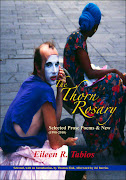
Here's a review of Virgil's wonderful book by Leny over HERE!

Once upon a time the eyewitness to the rituals of a Babaylan (http://en.wikipedia.org/wiki/Babaylan; http://www.babaylan.net) told of her altered states of consciousness when she did her healing, her communing with the spirits. They didn’t understand her language but they accepted the efficacy of her relationship with the spirit world. They trusted her. They knew she had access to this world. (Why else did the Spanish friars in the 15th century embark on the project of exterminating these Babaylans?). [3]
Does a poet like Eileen also perform, symbolically, the role of a Babaylan? If the Babaylan is able to ferry a person in-between worlds, or is able to summon a wandering soul back to the body, or plead with the spirits to be kind and generous, or negotiate a propitiation—can a Babaylan-inspired poet do the same?
Sometimes reading poetry, for me, is learning how to dive for one’s own meaning. In diving one learns, senses, embodies. This I have learned from my engagement with Eileen’s body of work over the past decade. [4]
If according to Archbishop Fulton Sheen, The Rosary is “a meditation for the blind, the simple, the aged.” is it then possible that the The Thorn Rosary is that which pricks the meditation in order to return us to our own bodies? Our bodies that aren’t blind, not simple, not aged.
Isn’t this the work of babaylan poetics—to walk the angel back into its body in unborrowed light. Eileen creates her own light, a luminosity that is also sorrowful, joyful, glorious…the light is unborrowed because it has already taken upon itself all that there is—the world into the poem. It doesn’t ask for a return, only an invitation to dance. The dance of the babaylan.
Isn’t this what the babaylan does? She dances. In wholeness. In ecstasy. A body out of time and space. And when she doesn’t literally dance, she writes Poems that dance. The Poem, like this one, takes your hand and leads your sensuous mind, this mind that descends into the body to become whole and sacred:
Restive
—after “on God (en Garde)” by Archie Rand
The farmers are monitoring the sky. Rain dilutes sweetness in the grapes. Knuckles knot into themselves, mimic the knees of hundred-year-old grapevines. The cabernet hang like purple testicles. I am always fingering a bunch. Sometimes I pinch off a globe, split its skin before my lips and suck at its membrane. The farmers measure brix mathematically. I want my body to determine truth like Cezanne painted rocks instead of images. When I see the winged shadow glide over the fruit-laden fields of September’s wine country, I know better than to question how my body doubles over. How my mouth gasps. I feel blood flowing out of a creature, somewhere, felled on its path. Its last vision will be a vulture’s open beak. Sweetness, let the harvest begin under the most livid sun. “Sweetness” —perhaps I mean You, dear “God.” Lord, I am praying for life and living—I am making poems. (161)
Hail Mary, mother of Eileen. Blessed are we and blessed are the fruits of our wombs….
The concept that the Babaylan is defined by factors that override an individual’s direct experience of the originating land, the Philippine Islands, is vital to understanding the presence of the Babaylan in the Diaspora and the ways that sacred practices of the Babaylan have, as well, bridged the seas of consciousness that Pilipinos have traversed in their journeys around the world.
...
If we accept that Culture is a human construct, by which a group of individuals agree basic concepts of values, morals, mores to form a worldview, then it follows that Culture evolves as humans evolve.
...
While many may provide their perspectives, and assist in our discoveries, through critical analysis founded in scientific methodology, it is up to us to decide who we are and where we are headed.


STATEMENT
I am also to blame for the BP oil disaster. I am part of the demand for oil. I do try to limit my footprint on the natural environment, in energy and other matters. For the former, say, a solar field; for the latter, say, hosting bee hives to help mitigate “colony collapse disorder” which also is a way to introduce my son to environmental concerns. But regardless of these steps, I do not wish to avoid acknowledging that I am part of the cause for the tragedy in the Gulf and many other environmental damages—to recognize blame’s expanse is a condition precedent for being part of any solution. As Acoma Pueblo poet Simon J. Ortiz has noted, there is a “moral imperative” to the making of interconnections that require, among other things, pro-active awareness including self-awareness—a stance also inherent in the Filipino indigenous trait of “kapwa” and what I call “Babaylan Poetics.” Ergo, for the BP oil disaster: I am very sorry—I will try to do better.