there was BABAYLAN POETICS. Here's a new Babaylan video featuring timeless intellectual Leny M. Strobel. What's interesting, among many things, is how the video opens. It features Virgil Mayor Apostol (of the infamous FART) opening up one of the events during the Babaylan Conference a few months ago. Specifically, he is talking in Ilokano, saying "Bari, bari" which can be literally translated as "Go away."
But it's not an aggressive order for anyone to move away. The chant is more of a charm to drive away unwanted spirits, while allowing benevolent ones to remain. As Virgil explained to me, "This goes back to how our ancestors feared the malevolent spirits, thus much prayers and offerings going to them, rather than the good ones since they did no harm. Therefore, the focus on the chant for the opening is for the purification of the space, and everyone within."
Virgil adds, "The burning of anglem (cloth incense) is universal in northern Luzon, and used for various circumstances from the birth of a child, illness, to the death of an individual. With its inclusion in the opening ceremony, its purpose is to drive away these malevolent spirits."
Very interesting, and a helpful explanation to me since, when I first heard of the literal translation, I was struck by its use. That is, since the Babaylan is about community and inclusiveness, I found it interesting that this "Go away" is the opening. Mom said that the chant also refers to how, as we walk the earth, we are telling the spirits to move away so that we do not inadvertently step on them or otherwise harm them with our movements.
In the video opening, Virgil also goes on to say to the spirits, "We do not want anything from you..." I like that! My initial reaction was: Well, how's that for anti-colonialism!
These chants go ... deep (grin).
You know, ever since the Babaylan conference at Sonoma, I'd be walking about Galatea's mountain chanting, "Bari, Bari..."
Mom used to shush Moi, saying I'd actually bring the spirits here. Thing is, those spirits never left Moi. Blood memory and all that. Wink.
Sunday, October 10, 2010

Friday, October 8, 2010
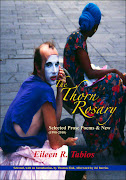
A BABAYLAN-IC PERSPECTIVE ON REVIEWING THE THORN ROSARY

I am so grateful to Leny M. Strobel for her engagement with my book THE THORN ROSARY in the new issue of Moria Poetry! Here is an excerpt--though you can see entire review HERE:
Once upon a time the eyewitness to the rituals of a Babaylan (http://en.wikipedia.org/wiki/Babaylan; http://www.babaylan.net) told of her altered states of consciousness when she did her healing, her communing with the spirits. They didn’t understand her language but they accepted the efficacy of her relationship with the spirit world. They trusted her. They knew she had access to this world. (Why else did the Spanish friars in the 15th century embark on the project of exterminating these Babaylans?). [3]
Does a poet like Eileen also perform, symbolically, the role of a Babaylan? If the Babaylan is able to ferry a person in-between worlds, or is able to summon a wandering soul back to the body, or plead with the spirits to be kind and generous, or negotiate a propitiation—can a Babaylan-inspired poet do the same?
Sometimes reading poetry, for me, is learning how to dive for one’s own meaning. In diving one learns, senses, embodies. This I have learned from my engagement with Eileen’s body of work over the past decade. [4]
If according to Archbishop Fulton Sheen, The Rosary is “a meditation for the blind, the simple, the aged.” is it then possible that the The Thorn Rosary is that which pricks the meditation in order to return us to our own bodies? Our bodies that aren’t blind, not simple, not aged.
Isn’t this the work of babaylan poetics—to walk the angel back into its body in unborrowed light. Eileen creates her own light, a luminosity that is also sorrowful, joyful, glorious…the light is unborrowed because it has already taken upon itself all that there is—the world into the poem. It doesn’t ask for a return, only an invitation to dance. The dance of the babaylan.
Isn’t this what the babaylan does? She dances. In wholeness. In ecstasy. A body out of time and space. And when she doesn’t literally dance, she writes Poems that dance. The Poem, like this one, takes your hand and leads your sensuous mind, this mind that descends into the body to become whole and sacred:
Restive
—after “on God (en Garde)” by Archie Rand
The farmers are monitoring the sky. Rain dilutes sweetness in the grapes. Knuckles knot into themselves, mimic the knees of hundred-year-old grapevines. The cabernet hang like purple testicles. I am always fingering a bunch. Sometimes I pinch off a globe, split its skin before my lips and suck at its membrane. The farmers measure brix mathematically. I want my body to determine truth like Cezanne painted rocks instead of images. When I see the winged shadow glide over the fruit-laden fields of September’s wine country, I know better than to question how my body doubles over. How my mouth gasps. I feel blood flowing out of a creature, somewhere, felled on its path. Its last vision will be a vulture’s open beak. Sweetness, let the harvest begin under the most livid sun. “Sweetness” —perhaps I mean You, dear “God.” Lord, I am praying for life and living—I am making poems. (161)
Hail Mary, mother of Eileen. Blessed are we and blessed are the fruits of our wombs….
Thank you, Leny. I appreciate this Babaylan-ic perspective for reviewing my newest book. It's a unique gift!
Friday, August 27, 2010
BABAYLANISM AT OUR OWN VOICE
This is actually a reprint of a post I just featured at my primary blog, but I replicate it below for convenience:
BABAYLANISM
OurOwnVoice's newest issue is rather historic by focusing on the Babaylan.
I've got three poems innit, which isn't the most important detail but which I note for moi Blog-File ("Hay(na)ku with Ducktail for Leny", "The Hundredth Monkey Phenomenon," and "Sacred Time"). Again for the Blog-File, I also have the novel "Dear Cloud" innit.
Having gotten Housekeeping out of the way, I found this essay by Cynthia Arias, "An American Babaylan: Living in One's Own Truth" quite useful. It's useful because modern-day Babaylanism is controversial in some circles as people grapple with the effect of the diaspora (and the resultant separation from "land"). Anyway, here's some excerpts from Arias' essay:
Modern-day Babaylanism is empowering.
The Babaylan Conference, which seeded this issue, also empowered Mom to write her first book (which I'm reviewing now). But here is also one of her narratives, a memoir from 1939 entitled "Dawac". Good for Mom!
Also useful is the essay "Ways of the Babaylan" by Katrin de Guia. It's clear from her essay that empathizing/understanding (in my opinion, if you understand Babaylanism, understanding cannot occur without empathizing) cannot occur without that thing that many folks are scared to discuss: love. I do think Ben Okri's quote relevant: "Only those who truly love and who are truly strong can sustain their lives as a dream. You dwell in your own enchantment. Life throws stones at you, but your love and your dream change those stones into the flowers of discovery."
It takes courage to love as a Babaylan would/does. For, as de Guia puts it, "The first priority of the babaylan is the community."
I appreciate Babaylanism because it requires intelligent innocence.
BABAYLANISM
OurOwnVoice's newest issue is rather historic by focusing on the Babaylan.
I've got three poems innit, which isn't the most important detail but which I note for moi Blog-File ("Hay(na)ku with Ducktail for Leny", "The Hundredth Monkey Phenomenon," and "Sacred Time"). Again for the Blog-File, I also have the novel "Dear Cloud" innit.
Having gotten Housekeeping out of the way, I found this essay by Cynthia Arias, "An American Babaylan: Living in One's Own Truth" quite useful. It's useful because modern-day Babaylanism is controversial in some circles as people grapple with the effect of the diaspora (and the resultant separation from "land"). Anyway, here's some excerpts from Arias' essay:
The concept that the Babaylan is defined by factors that override an individual’s direct experience of the originating land, the Philippine Islands, is vital to understanding the presence of the Babaylan in the Diaspora and the ways that sacred practices of the Babaylan have, as well, bridged the seas of consciousness that Pilipinos have traversed in their journeys around the world.
...
If we accept that Culture is a human construct, by which a group of individuals agree basic concepts of values, morals, mores to form a worldview, then it follows that Culture evolves as humans evolve.
...
While many may provide their perspectives, and assist in our discoveries, through critical analysis founded in scientific methodology, it is up to us to decide who we are and where we are headed.
Modern-day Babaylanism is empowering.
The Babaylan Conference, which seeded this issue, also empowered Mom to write her first book (which I'm reviewing now). But here is also one of her narratives, a memoir from 1939 entitled "Dawac". Good for Mom!
Also useful is the essay "Ways of the Babaylan" by Katrin de Guia. It's clear from her essay that empathizing/understanding (in my opinion, if you understand Babaylanism, understanding cannot occur without empathizing) cannot occur without that thing that many folks are scared to discuss: love. I do think Ben Okri's quote relevant: "Only those who truly love and who are truly strong can sustain their lives as a dream. You dwell in your own enchantment. Life throws stones at you, but your love and your dream change those stones into the flowers of discovery."
It takes courage to love as a Babaylan would/does. For, as de Guia puts it, "The first priority of the babaylan is the community."
I appreciate Babaylanism because it requires intelligent innocence.
Sunday, August 1, 2010
MOM'S FIRST READING!
As I've mentioned before, my nearly 81-year-old Mom has a first book coming out! In celebration of such, she also had her first "salon" (oh my!) reading experience this weekend, as she read from her narrative (she's calling these memoir-vignettes "narratives") "Dawac" at beautiful Leny's beautiful house (it was so colorfully and, wink, indigenous-ly decorated!). Here's a photo of Mom in her reading chair--do note in the foreground a make-shift "altar" of blessings that Leny created on the spot from vegetables that I brought from my garden (that's when I realized, btw, that you're supposed to harvest zucchinis when they're smaller, not when they become human baby-sized....duh). That's the beautiful back of the beautiful Leny's beautiful head in foreground:

Here's a shot, too, of part of the audience to whom I'm so grateful for their openness and making my Mom feel really welcome as she goes on to her own literary debut. That's Jean on the far-left side of couch! It's not a good photo, but you can see the intentness of the peeps' attention....

At one point in the evening, one lady said that writing must run in my family. And I said half-jokingly, "Yes, but I didn't know it for the longest time!"
And what I was thinking of is that when some talent runs in the family, one usually sees it first in the parent and then in the child. In my and Mom's case, it was seen visibly first -- if one uses publication as a viewsight -- in me and later in Mom. But what this really means is that what was running through our blood is not linear but circular...
...evoking for me indigenous time's mythical space of creativity: where, in the space of creation, there are no delineations between past, present and future, or between geographically-defined space; in that mythical space, unity exists in the universe across all time and space. (Got that? Good!)
Last but not least, I mentioned in my introduction for Mom that "Dawac" is the first narrative in Part One of her forthcoming book, and that Part Two will be a reprint of her Master's Thesis at Silliman University when she had written (under since-recognized Philippine National Artists Edilberto and Edith Tiempo) the first critical study of "local color" in Filipino English-language short story writing. I thought it wonderfully synchronistic that Mom's own narratives will contain much local color, even as I consider her book also a recovery project for what was actually a historic literary study. The circle turns....
Thanks again to Leny for the salon idea and hosting. Thanks for making Mom and me feel so welcome. What a beautiful community you all make!

Here's a shot, too, of part of the audience to whom I'm so grateful for their openness and making my Mom feel really welcome as she goes on to her own literary debut. That's Jean on the far-left side of couch! It's not a good photo, but you can see the intentness of the peeps' attention....

At one point in the evening, one lady said that writing must run in my family. And I said half-jokingly, "Yes, but I didn't know it for the longest time!"
And what I was thinking of is that when some talent runs in the family, one usually sees it first in the parent and then in the child. In my and Mom's case, it was seen visibly first -- if one uses publication as a viewsight -- in me and later in Mom. But what this really means is that what was running through our blood is not linear but circular...
...evoking for me indigenous time's mythical space of creativity: where, in the space of creation, there are no delineations between past, present and future, or between geographically-defined space; in that mythical space, unity exists in the universe across all time and space. (Got that? Good!)
Last but not least, I mentioned in my introduction for Mom that "Dawac" is the first narrative in Part One of her forthcoming book, and that Part Two will be a reprint of her Master's Thesis at Silliman University when she had written (under since-recognized Philippine National Artists Edilberto and Edith Tiempo) the first critical study of "local color" in Filipino English-language short story writing. I thought it wonderfully synchronistic that Mom's own narratives will contain much local color, even as I consider her book also a recovery project for what was actually a historic literary study. The circle turns....
Thanks again to Leny for the salon idea and hosting. Thanks for making Mom and me feel so welcome. What a beautiful community you all make!
Saturday, June 12, 2010
POETS FOR LIVING WATERS
I'm pleased to be part of the Poets for Living Waters project curated by Amy King and Heidi Lynn Staples in response to the BP oil spill disaster. Innit with a poem, statement of conscience and explication of Michael and his anti-colony collapse disorder beekeeping. The poem was one I wrote after the disastrous landslides in Guinsaugon, Leyte, Philippines on February 17, 2006.
I was happy, too, to be able to meld some Babaylan Poetics/indigenized POV into that conscience-statement, which I replicate here:
Colony collapse disorder, landslides from reaping trees from mountain, BP's oil spill in the Gulf -- we are all complicit, because we are interconnected.
I was happy, too, to be able to meld some Babaylan Poetics/indigenized POV into that conscience-statement, which I replicate here:
STATEMENT
I am also to blame for the BP oil disaster. I am part of the demand for oil. I do try to limit my footprint on the natural environment, in energy and other matters. For the former, say, a solar field; for the latter, say, hosting bee hives to help mitigate “colony collapse disorder” which also is a way to introduce my son to environmental concerns. But regardless of these steps, I do not wish to avoid acknowledging that I am part of the cause for the tragedy in the Gulf and many other environmental damages—to recognize blame’s expanse is a condition precedent for being part of any solution. As Acoma Pueblo poet Simon J. Ortiz has noted, there is a “moral imperative” to the making of interconnections that require, among other things, pro-active awareness including self-awareness—a stance also inherent in the Filipino indigenous trait of “kapwa” and what I call “Babaylan Poetics.” Ergo, for the BP oil disaster: I am very sorry—I will try to do better.
Colony collapse disorder, landslides from reaping trees from mountain, BP's oil spill in the Gulf -- we are all complicit, because we are interconnected.
Saturday, June 5, 2010
...MAKING THEIR WAY OUT TO THE WORLD...WHICH HAD NEVER LEFT THEIR WORDS...
Okay. So some of the early fruits of creativity spurred on by the Babaylan Conference are now making their way out into the world!
For Mom, this means her memoir-short story "Dawac" has been sent for future publication in the Babaylan Special Issue forthcoming from OurOwnVoice. For me, two poems ("The Hundredth Monkey Phenomenon" and "Sacred Time") from the five Babaylan-poems I've written so far have just been accepted for -- UPDATE: and are now published in -- OCHO 30, a literary journal edited by Didi Menendez.
Here's an excerpt from Mom's memoir "Dawac":
*****
And here's an excerpt from my poem "The Hundredth Monkey Phenomenon":
For Mom, this means her memoir-short story "Dawac" has been sent for future publication in the Babaylan Special Issue forthcoming from OurOwnVoice. For me, two poems ("The Hundredth Monkey Phenomenon" and "Sacred Time") from the five Babaylan-poems I've written so far have just been accepted for -- UPDATE: and are now published in -- OCHO 30, a literary journal edited by Didi Menendez.
Here's an excerpt from Mom's memoir "Dawac":
I did not go to school the following day. I wanted to see what a dawac was. Apo Kattim arrived with her assistant. I noticed that she brought a long buneng (long knife) in its wooden sheath. She went to the bedroom to see Eliel right away, then returned to the descanso where we waited. Since the descanso was cleared of all the chairs, Apo Kattim and her assistant remained standing while they talked. My grandmother invited them to the kitchen for coffee. Apo Kattim said coffee would be good because although they had breakfast, they did not have time for coffee.
After they had their coffee, Apo Kattim returned to the descanso and asked to see the coconuts. She nodded her approval when she saw that they were well husked. My mother also pointed to the rolled floor mat placed against the wall. Apo Kattim unsheathed the buneng and place it on the table. She handed the sheath to her assistant who placed it under the table. The assistant took a folded dinwa and placed it on a corner of the table. Apo Kattim and her assistant unrolled the floor mat and spread it on the floor, leaving enough space between it and the wall to allow a person to walk around it. Then Apo Kattim asked for a drinking glass.
“With water?” asked Tiang Ciliang.
“No,” said the assistant, “just the glass.”
Tiang Ciliang went to the kitchen and came back with the drinking glass. The assistant took it and placed it on the table. She placed a long piece of metal beside it.
Apo Kattim looked at all the things on the table then asked for the blanket that she told my mother to prepare. My grandmother brought a folded blanket. Apo Kattim’s assistant took it and spread it on the floor. Apo Kattim told my mother to sit on the blanket. Then she turned to Manong Toring and told him to bring Eliel out. “And cover him with his blanket when you bring him out,” she said.
“And now that Eliel will not be on his bed for sometime, somebody should change all his bed linens,” Apo Kattim suggested.
Manong Toring came back with Eliel in his arms, the blanket trailing the floor.
“Don’t trip on the blanket,” cautioned Tiang Ciliang, walking toward them and catching the part of the blanket that reached all the way down to the floor. If Manong Toring had stepped on that part of the blanket, he would surely have stumbled with Eliel in his arms.
“Put him down here,” directed Apo Kattim, pointing to the spot near my mother. “Sit him facing the wall.”
As soon as Eliel was seated properly, Tiang Ciliang walked to Eliel’s bedroom. Somebody had to change Eliel’s bed linens.
“Move closer to Eliel and hold him up,” Apo Kattim told my mother. “He still can’t sit up by himself.”
Apo Kattim placed the flat basin behind Eliel. Then she turned to us and warned us not to talk or move around while she was doing the dawac. She also told Manong Toring to stand near the stairs and stop the people below from coming up when they heard her chanting, or stop them from talking in loud voices.
Some neighbors must have heard that a mannawac was in our house and they came to satisfy their curiosity. However, they sat on the benches under the house. They did not come up.
Apo Kattim took the dinwa, nodded to her assistant, and sat down near Eliel. She covered her head with the dinwa and extended her right hand. Her assistant gave her the piece of metal. Apo Kattim extended her left hand. Her assistant placed the drinking glass in her hand, guiding Apo Kattim’s fingers to hold the glass securely.
Everyone was quiet. I felt funny in the eerie silence. Apo Kattim started hitting the drinking glass with the piece of metal. The dawac started. Apo Kattim was calling to the anitos and summoning them to come to her assistance.
“O – O – O – O – O – O,” Apo Kattim ‘s ululating cry accompanied by the tinkling sounds of the glass could be heard could be heard by the whole neighborhood.
“Umali cayo Isna. (Come here.) Umali cayo ta i- la-enyo od nan masakit ay anac si Inggo.” Apo Kattim was calling the anitos to come and see the sick son of Inggo. (Inggo was my late father’s name.)
“O – O – O – O – O – O. Masegang cayo. (Have pity.) Masegang cayo isnan ubing, Masegang cayo. Umali cayo,” was the repeated cry of Apo Kattim. “Umali cayo ta palaingen yo nan ubing ta umey met maki ayayam issa ayan dey appoyo.” She continued her call, then stopped striking the glass with the metal. Her assistant took the drinking glass and metal from her and put them back on the table.
Suddenly, Apo Kattim stood up, removed the dinwa that covered her head and flung it to her assistant. She looked strange to me, as though she had become a different person. She walked to the table, picked up her buneng, held it high with her right hand above her head, and started dancing around Eliel and my mother, waving her buneng in circular motions. Throughout, she chanted words in the Itneg dialect that I couldn’t understand. I began to be afraid that she might get dizzy and fall with that buneng in her hand. I looked around and saw that Manong Toring also looked concerned and was ready to come to Apo Kattim’s aid in case she fell.
Apo Kattim danced to the table and took one of the coconuts with her left hand, extended it and quickly brought her buneng down, splitting the coconut in halves. I heard everybody gasp in surprise and wonder. Who would expect a frail old woman to have the strength she showed when she split the coconut?
*****
And here's an excerpt from my poem "The Hundredth Monkey Phenomenon":
The nearby sea was calm
its clear water
mirroring distant mangroves and islets
to transform them into clouds
floating in the vast, pale blue—
In her slow and lilting voice
U’po Majiling chanted
Everything begins with a dream—
Tuesday, May 18, 2010
MOM'S FORTHCOMING AND FIRST BOOK!
The Babaylan Conference was so inspiring for Mom that since that weekend, she's been writing memoir-ish stories. In a matter of weeks, she's written enough for a book! And it'll actually be a useful memoir for others outside the family since much of the vignettes have to do with life during World War II, and many of Mom's peers have died or are dying (Mom is 80 years old). I actually already have a publisher for her first short story--fittingly, it will be for OurOwnVoice's special issue on Babaylan Conference Reflections...
Mom actually suffered physically from the prolonged hours spent over the computer writing her memoirs. But it's not unusual for the act of creation to take a toll on the body, the artists' bodies. It'll be worth it, though. Mom agreed with my suggestion to make her book a two-part book. The first part will be her memoirs. The second part will be -- wait for it as it's HISTORIC! -- a reprint of her May 1954 Masters of Arts Degree in English from Silliman University. Mom's thesis was on "The Use of Local Color in Philippine Short Stories in English" -- the first critical study on this topic.
I'm looking at Mom's thesis right now as I type this post--it was approved by the "Graduate Council" chaired at the time by now-Philippine National Artist Edith Tiempo, and Council members were Metta J. Silliman and Philippine National Artist Edilberto Tiempo. (Mom had studied at Silliman University with the Tiempos, but before they set up the writers' program modeled after Iowa University's.) The pages are yellowing...browning....fragile.
It will be great to get this thesis out there!
And here's a picture of my mother Beatriz Tabios reading a copy of THE THORN ROSARY. She happened to be in the kitchen when my copies of the hardback versions were delivered. It's nice to see that she thought my book was worth interrupting her mending of dish towels (grin).

When my father died a few years ago, it was just short of his and Mom's 50th wedding anniversary. It's often said that the first year of widowhood is the most difficult, and for a couple that's been together for so long, it could be even more difficult. In a way, the writing has become a new source of invigoration for Mom, a reason to look forward instead of (what she usually does): look back into her memories.
She looks forward by looking back? Hey -- time just collapsed in that mythic "sacred time and sacred place" where creativity fluorishes! Woot! And it's all because, at the last minute and a tad bored around the house, she decided to attend the Conference with me. She loved it so much she returned for the second-day attendance. And, now, she's pouring out her own contribution to ... Light!
Mom actually suffered physically from the prolonged hours spent over the computer writing her memoirs. But it's not unusual for the act of creation to take a toll on the body, the artists' bodies. It'll be worth it, though. Mom agreed with my suggestion to make her book a two-part book. The first part will be her memoirs. The second part will be -- wait for it as it's HISTORIC! -- a reprint of her May 1954 Masters of Arts Degree in English from Silliman University. Mom's thesis was on "The Use of Local Color in Philippine Short Stories in English" -- the first critical study on this topic.
I'm looking at Mom's thesis right now as I type this post--it was approved by the "Graduate Council" chaired at the time by now-Philippine National Artist Edith Tiempo, and Council members were Metta J. Silliman and Philippine National Artist Edilberto Tiempo. (Mom had studied at Silliman University with the Tiempos, but before they set up the writers' program modeled after Iowa University's.) The pages are yellowing...browning....fragile.
It will be great to get this thesis out there!
And here's a picture of my mother Beatriz Tabios reading a copy of THE THORN ROSARY. She happened to be in the kitchen when my copies of the hardback versions were delivered. It's nice to see that she thought my book was worth interrupting her mending of dish towels (grin).

When my father died a few years ago, it was just short of his and Mom's 50th wedding anniversary. It's often said that the first year of widowhood is the most difficult, and for a couple that's been together for so long, it could be even more difficult. In a way, the writing has become a new source of invigoration for Mom, a reason to look forward instead of (what she usually does): look back into her memories.
She looks forward by looking back? Hey -- time just collapsed in that mythic "sacred time and sacred place" where creativity fluorishes! Woot! And it's all because, at the last minute and a tad bored around the house, she decided to attend the Conference with me. She loved it so much she returned for the second-day attendance. And, now, she's pouring out her own contribution to ... Light!
Subscribe to:
Posts (Atom)